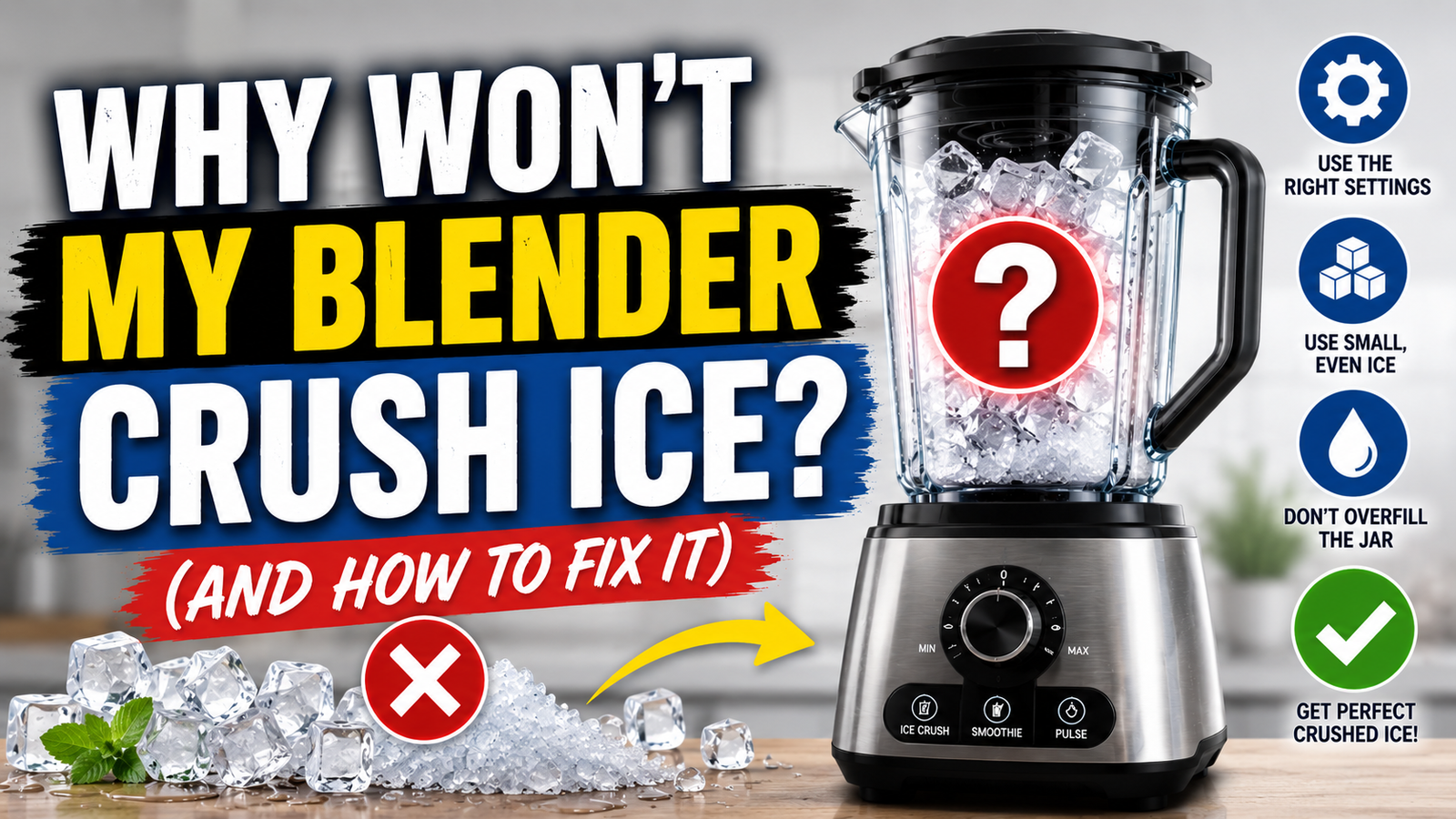

Why Won’t My Blender Crush Ice? (And How to Fix It)
If you put some ice cubes in your blender and press the button, you won’t get smooth, snow-like slush. Instead, you’ll hear a horrible grinding sound, see a few chips flying around the edges, and see a solid chunk of ice stuck in the middle. If this sounds like you, you’re not alone—it’s one of the most common problems with blenders. The good news is that most of the time, these problems can be fixed. Let’s look at what’s going on.
1. You’re Not Using Enough Liquid
Something must be able to move through ice. If you put in a bunch of dry ice cubes that don’t have much or any water on them, the blades won’t be able to “grab” them. The ice will just spin around or sit on top of them instead of being pulled down into them.
To fix it, add some liquid (water, juice, milk, etc.) before you blend it. It only takes a few tablespoons to make the vortex that pulls the ice down toward the blades.
2. The Ice-to-Liquid Ratio Is Off
When there is too much ice and not enough liquid, it forms a thick mass that is hard for the motor to move through. If there is too much water, the ice will rise and avoid the blades.
Fix: About 1 cup of liquid to every 1 to 2 cups of ice is a good starting point. You can change the amounts to suit your taste and consistency. Instead of adding all the ice at once, do it slowly.
3. Your Blender Simply Isn’t Built for Ice
Not every blender is the same. Cheaper or lower-wattage blenders (especially those under 500 watts) are usually made for soft fruits, smoothies, and purees. They won’t be able to handle the force of thick, frozen ice cubes. Forcing them to crush ice over and over again can damage the motor or the blades over time.
Fix: Check your blender’s instructions or the specs from the maker to see if it can crush ice. If it’s not, try using ice cubes that are crushed or smaller, or buy a blender that can handle ice and frozen foods.
4. The Blade Design Doesn’t Suit Ice
Some blade shapes are better at cutting through liquids and soft foods than solid ice. For example, flat or shallow blades may not be as good at it as cross-shaped or multi-tiered blades. Fix: If you regularly crush ice, look for a blender with blades that are made for that purpose (often called “ice crush” blades or having a stacked, multi-level design).
5. The Ice Cubes Are Too Large
It’s harder for blades to catch and break down big ice cubes because they take up more space. Also, they might make the motor work harder.
Fix: Instead of big ice cubes, use smaller ones, crush them, or let the big ones sit at room temperature for a minute or two to soften up a bit before you blend them.
6. You’re Overloading the Jar
When you put ice all the way to the top of the blender jar, there is no room to move.
Fix: Don’t overfill the blender; instead, blend in smaller amounts. This makes the regularity more even and also makes the motor work less hard.
7. The Motor Is Underpowered or Struggling
The motor may not have enough torque to handle the load if your blender slows down, stops, or makes a labored humming sound when it hits ice. This is more likely to happen with older or more heavily used machines.
Fix: Instead of moving all the time, try pulsing. Short bursts can work better than one long, forced blend because they give the motor a chance to rest. If you follow the right steps and the problem still happens, the motor may be worn out or not made for ice work.
8. Dull or Damaged Blades
Because blades wear down, chip, or come loose over time, they may not be able to cut through hard ice as well.
Fix: Look at your blades to see if they are damaged or worn down. If the blades are dull or the whole system feels loose, you might need a new blender or a new part.
Quick Troubleshooting Checklist
- ✅ Add liquid before adding ice
- ✅ Use a balanced ice-to-liquid ratio
- ✅ Blend in smaller batches
- ✅ Use smaller or crushed ice cubes
- ✅ Pulse instead of running continuously
- ✅ Check blade condition and sharpness
- ✅ Confirm your blender is rated for ice crushing
The Bottom Line
Most of the time, a blender that won’t crush ice isn’t broken; it’s just being asked to do something it wasn’t made to do, or it’s missing the right liquid, method, or batch size. Before you think the worst, try the easy fixes first (liquid mix, batch size, pulsing). Also, if your blender just won’t work with ice no matter what you do, it might be time to find one that was made to do that.








2 comments