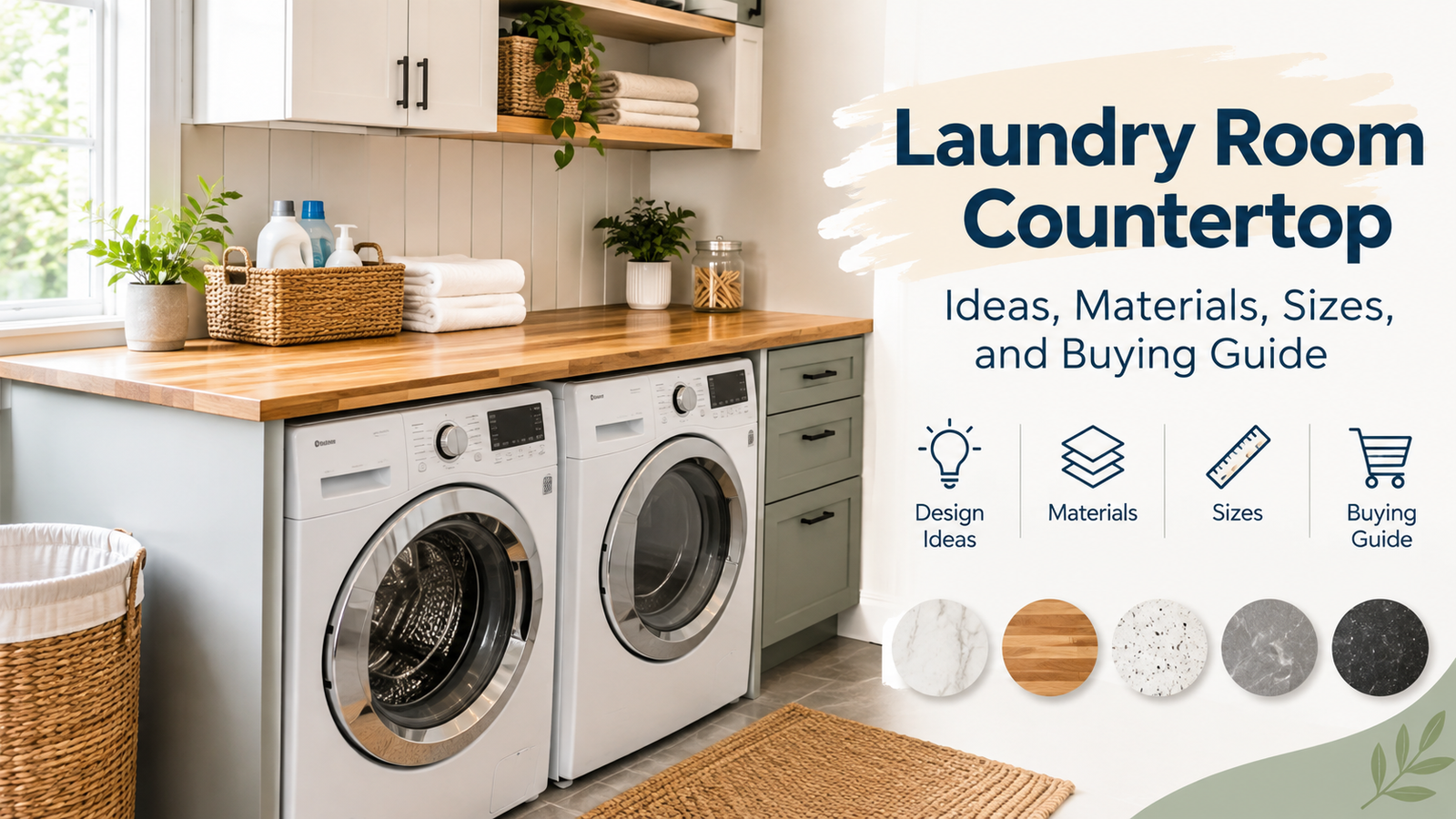

A well-thought-out countertop in the laundry room can make the space more useful, neat, and appealing. It doesn’t matter if you have a big laundry room or a small one in an apartment. Adding a countertop above or next to your washer and dryer can give you extra space to fold clothes, organize your supplies, and do other everyday laundry tasks.
With the right countertop, you can turn an empty space into a useful work area and make your laundry room look cleaner and more put together.
We’ll talk about the best countertop ideas for your laundry room, as well as the best materials, sizes, fitting tips, and storage options to help you make your laundry area useful.
What Is a Counter top washer?
A countertop washer is a strong work station that is put in or near a laundry room. It is usually put on top of a front-loading washer and dryer to make a flat area for folding.
Depending on how the room is set up, a countertop can also be put in:
- Beside the washing machine
- Above storage cabinets
- Over laundry hampers
- Along an empty wall
- Above a compact washer
- Around a utility sink
A countertop can provide both practical workspace and additional opportunities for storage.
Why Add a Countertop to a Washing Machine?
A countertop isn’t essential for operating a washing machine, but it can significantly improve the usability of your laundry area.
1. Create a Folding Station
Having a specific place to fold clothes is one of the best things about it.
You don’t have to move clean clothes to another room; you can fold them as soon as you take them out of the dryer.
It’s much easier to fold towels, shirts, pants, and other clothes on a wide, smooth surface.
2. Make Use of Empty Space
Front-loading washers and dryers make space above them that can be used for other things.
By adding a countertop on top of them, you can use that space as a work surface.
This is very helpful in laundry rooms that aren’t very big because every inch counts.
3. Get things in order
A countertop can be used to set aside laundry baskets, folded clothes, detergent, and other things that you use often.
When added to cabinets or shelves, they can make a laundry station that is very well organized.
4. Give it a finished look
If you match the countertops and cabinets in your laundry room, it will look more organized and like it was professionally designed.
Simple tools can look more like they belong in a room with even a simple countertop.
The best ideas for laundry room countertops Depending on the size of your room and how your appliances are set up, there are many ways to design a laundry countertop.
Top of the washer and dryer on the counter
A countertop that is put right on top of front-loading appliances is one of the most popular styles.
This makes a big space for folding while making good use of vertical space.
Before you put one in, make sure there is enough space around the machines for doors, hoses, ventilation, and maintenance.
Countertop With Cabinets
For maximum storage, combine the countertop with lower cabinets.
The cabinets can store:
- Laundry detergent
- Fabric softener
- Cleaning products
- Towels
- Laundry bags
- Extra hangers
- Household supplies
This design works particularly well when the countertop extends across the entire wall.
Countertop With Open Shelving
Open shelving above or beside the countertop provides easy access to commonly used items.
Baskets can be used to keep smaller laundry supplies organized while maintaining a clean appearance.
Countertop Around a Utility Sink
If your laundry room has a utility sink, you might want to extend the countertop around it to make more space. This will give you a place to treat stains, wash clothes by hand, or do other cleaning tasks around the house.
Small Laundry Room Countertop
Even a compact laundry room can benefit from a countertop.
A narrow work surface beside or above the appliances can provide enough space for folding small loads or storing laundry supplies.
Best Materials for a Laundry Room Countertop
Choosing the right material is important because laundry rooms can experience moisture, spills, heat, and frequent use.
Laminate
Laminate is one of the most affordable countertop options.
Advantages include:
- Affordable price
- Many colors and patterns
- Easy cleaning
- Relatively simple installation
- Lightweight construction
Modern laminate can mimic the appearance of wood, stone, or other premium materials.
Butcher Block
Butcher block gives a laundry room a warm, natural appearance.
Wood countertops work especially well in laundry rooms with farmhouse, traditional, or modern-natural designs.
However, wood requires appropriate sealing and maintenance to protect it from moisture.
Quartz
Quartz is a premium countertop option known for its durability and low-maintenance surface.
It offers a polished appearance and is resistant to many common household stains.
The downside is that quartz can be considerably more expensive than laminate or wood.
Granite
Granite is another durable option for a high-end laundry room.
It provides a natural stone appearance and can withstand heavy everyday use.
However, granite is heavy, expensive, and generally requires professional installation.
Solid Surface
Solid-surface countertops provide a seamless appearance and are available in many designs.
They can be a good middle-ground option between inexpensive laminate and premium natural stone.
What Is the Best Countertop Height?
The ideal countertop height depends on your appliances and how you intend to use the surface.
When a countertop is put in front of a front-loading washer or dryer, it is usually made to fit the washer or dryer’s height instead of a standard kitchen countertop height.
Measure your appliances before ordering or cutting the countertop.
Remember to account for:
- Appliance height
- Countertop thickness
- Wall clearance
- Appliance vibration
- Water hoses
- Electrical connections
- Dryer ventilation
- Access for maintenance
Don’t assume that two appliances have exactly the same dimensions. Measure each appliance carefully.
How Deep Should a Laundry Room Countertop Be?
The depth of your countertop should usually match the depth of your washer and dryer.
If the countertop is too shallow, it might not cover the appliances well enough, and if it’s too long, it can get in the way of doors or walkways.
Find out how deep the appliances really are, taking into account any space that needs to be left behind them.
If your laundry room is small, a table that is a little less deep might help you save floor space.
Countertop Over a Washer and Dryer: Important Considerations
Installing a countertop directly over appliances requires more planning than simply placing a board on top.
Allow Appliance Movement
Washing machines can vibrate during high-speed spin cycles.
The countertop should not interfere with the movement or operation of the appliances.
Consider Appliance Access
You may eventually need to repair or replace your washer or dryer.
Avoid designing a countertop installation that makes appliance removal unnecessarily difficult.
Check Ventilation Requirements
Dryers require proper ventilation and airflow according to the manufacturer’s installation instructions.
Never block required ventilation or create a countertop arrangement that interferes with the dryer’s exhaust system.
Secure the Countertop Properly
A countertop should be properly supported and secured according to its material and installation method.
Heavy materials such as stone require appropriate structural support.
Laundry Room Countertop Storage Ideas
A countertop becomes even more useful when combined with smart storage.
Use Storage Baskets
Baskets can hold:
- Socks
- Cleaning cloths
- Laundry accessories
- Delicates
- Extra supplies
Choose baskets that fit neatly beneath shelves or inside cabinets.
Install Floating Shelves
Floating shelves above the countertop can keep everyday laundry products within easy reach without taking up countertop space.
Add Wall Cabinets
Wall cabinets are excellent for keeping cleaning chemicals and other supplies contained.
If children are present in the household, potentially hazardous cleaning products should be stored securely and according to their labels.
Use Pull-Out Hampers
Built-in pull-out hampers can make sorting dirty laundry easier.
Consider separate compartments for whites, colors, towels, and other categories if that matches your laundry routine.
DIY Laundry Room Countertop
A laundry room countertop can be a manageable DIY project depending on the material and installation.
For a simple design, you may need:
- Accurate measurements
- Countertop material
- Support brackets or a suitable frame
- Level
- Drill
- Screws and appropriate anchors
- Saw, if cutting is required
- Sandpaper or finishing materials
- Appropriate sealant
Before starting, carefully plan where the washer, dryer, plumbing, electrical connections, and dryer vent will be located.
For stone countertops, complex electrical or plumbing work, or structural modifications, professional installation may be the safer option.
Laundry Room Countertop Design Tips
Keep the Surface Clear
A countertop works best when you have enough open space for folding clothes.
Instead of filling the entire surface with detergent bottles, use cabinets, shelves, or storage bins.
Match the Room
Choose a countertop that complements your cabinets, flooring, walls, and appliances.
White, wood-look, gray, and neutral surfaces are versatile choices that can work with many laundry room styles.
Prioritize Durability
Laundry rooms are functional spaces. Select a material that can handle moisture and regular cleaning.
Plan Around Your Appliances
Your countertop should work with your washer and dryer rather than restrict them.
Always check appliance dimensions and installation requirements before finalizing the design.
Common Laundry Room Countertop Mistakes
Installing Without Measuring
One of the most common mistakes is assuming standard appliance dimensions.
Measure the actual washer and dryer before purchasing materials.
Blocking Access
Don’t permanently block access to plumbing connections, electrical outlets, vents, or appliance service areas.
Choosing a Material Without Considering Moisture
Laundry rooms can experience water spills and humidity.
Make sure your chosen countertop material and finish are appropriate for the environment.
Making the Countertop Too Deep
A countertop that projects too far into the room can reduce walking space.
Measure the room carefully before installation.
Frequently Asked Questions
Not only does laminate work well, but so do butcher block, quartz, granite, and solid-surface materials. The best choice for you relies on your budget, the look you want, how long you want it to last, and how easy you want to keep it clean.
Yes. Over front-loading washers and dryers, countertops are often put in place.
But the installation has to make sure that the appliance can work properly and that it can be accessed for future repair.
The thickness varies on the material of the countertop and how it is supported. Make sure the holding structure is right for the material you chose and follows the manufacturer’s instructions.
Yes. Butcher block can provide an attractive and functional laundry surface, but it should be properly sealed and maintained to protect it from moisture.
The depth of the countertop should be planned around the size of the appliances and how they will be installed. It may be nice to have a little extra depth, but too much slope can make the floor less useful.
Final Thoughts
A well-thought-out countertop in the laundry room can turn an ordinary place for doing laundry into a more useful workspace. It doesn’t matter if you choose cheap laminate, warm butcher block, long-lasting quartz, or something else. The important thing is to plan your layout around your appliances and how you do your laundry every day.
In small laundry rooms, a bench above a front-loading washer and dryer can give you extra space for folding clothes without taking up any extra floor space. You can make things even more organized by adding cabinets, shelves, baskets, and hampers.
Before you begin, carefully measure the room and all of its tools. Also, think about what plumbing and air flow needs to be done. Finally, choose a material for the countertop that can handle water and regular use.
The best countertop for your laundry room isn’t just the one that looks good; it’s also the one that gives you useful space and keeps your room functional, accessible, and ordered.







