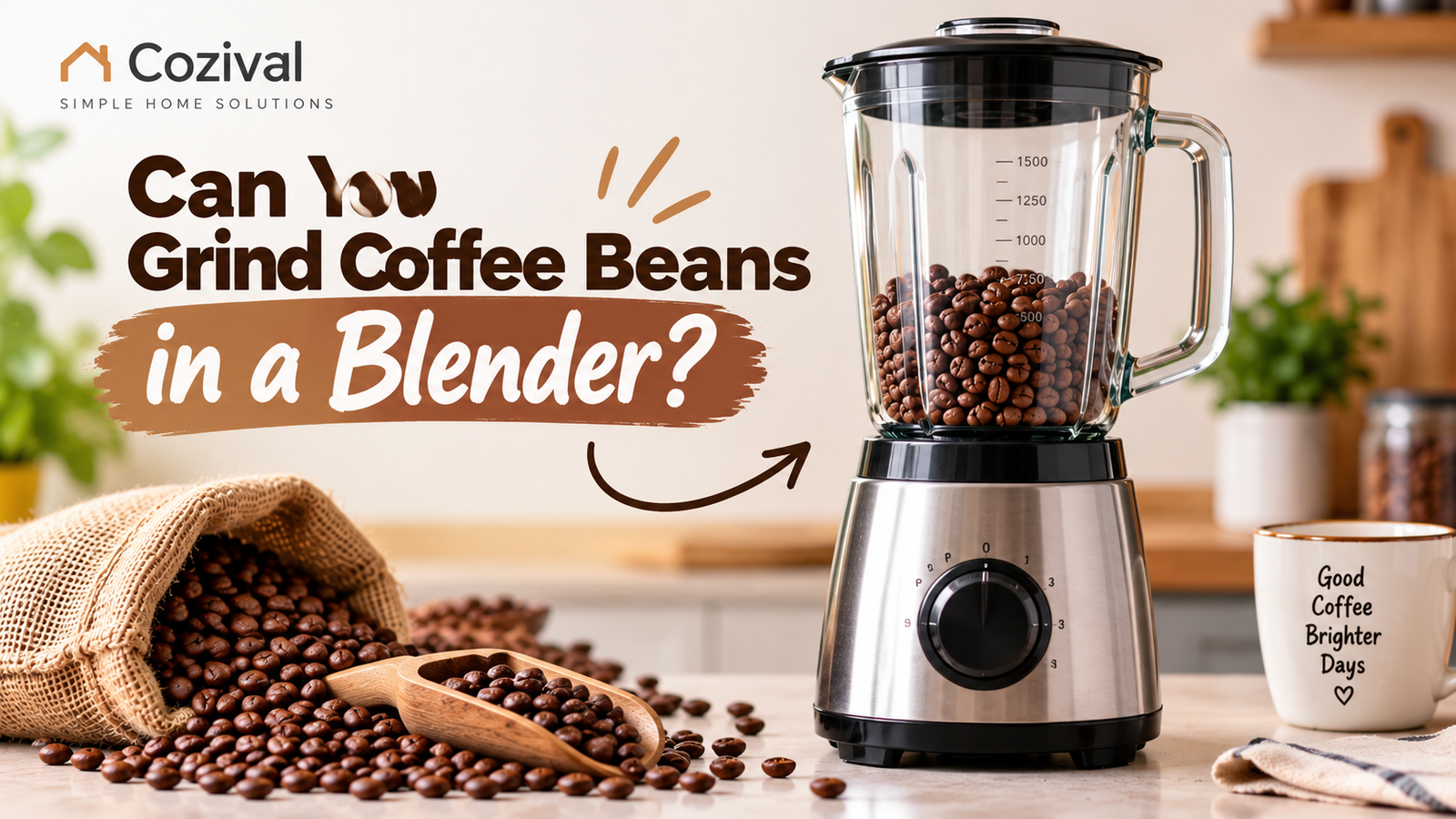

If you have coffee beans at home but don’t own a coffee grinder, you may wonder: Can you grind coffee beans in a blender?
Coffee beans can be ground in a blender, but it’s not always the best choice. You can use a blender to grind coffee beans into smaller pieces, but the results might not be even. This could change the taste and texture of your coffee.
As long as you know what you’re doing, you can use a mixer instead of a coffee grinder for a short time.
In this guide, we’ll explain how to grind coffee beans in a blender, what grind size to use, how much coffee to grind at once, and what mistakes to avoid.
Can You Grind Coffee Beans in a Blender?
Yes, coffee beans can be ground in a blender.
A lot of home blenders are strong enough to break up coffee beans into smaller pieces. As opposed to a coffee grinder, which is designed to grind coffee slowly and precisely, a mixer is mainly made to blend.
This means that the coffee grounds could be a wide range of sizes. It’s possible to get a mix of fine powder and bigger chunks.
If only used once in a while, this might be fine. If you make coffee often and want reliable results, a coffee grinder is usually a better choice.
Does a Blender Grind Coffee Beans Well?
A blender can grind coffee beans, but grind consistency is its biggest limitation.
How coffee is extracted depends a lot on the size of the particles. Some grounds will extract more quickly than others if they are very fine, while others will extract more slowly if they are much coarser.
This can contribute to coffee that tastes:
- Bitter
- Weak
- Over-extracted
- Under-extracted
- Inconsistent
For this reason, a blender is best considered a backup method rather than a replacement for a quality coffee grinder.
How to Grind Coffee Beans in a Blender
If you don’t have a grinder available, you can use your blender with the following method.
1. Measure the coffee beans
Start with just a few coffee beans.
Do not put beans in the blender container. It is easier for the blades to get to the beans in smaller amounts, and you may have more control over the grind.
2. Add the beans to the blender
Put the beans in the blender jar and make sure the lid is tight.
Before you put the beans in the blender, make sure it is clean and dry.
3. Use short pulses
Instead of running the blender continuously, use short pulses.
After a short pulse, stop and look at the texture. Do this again and again until the beans are almost the right size to grind.
Pulsing keeps the beans from just floating around the container and gives you more control over the end result.
4. Shake the container carefully
If your blender instructions permit it, you can stop the blender and gently shake the container between pulses to redistribute the beans.
Never shake or move the blender while the blades are operating.
5. Check the grind
Do not open the container until the blades have stopped moving.
Look around the grounds to see if they are mostly the same.
If you see a lot of big pieces, make the pulses last a little longer.
What Grind Size Should You Use?
The ideal grind size depends on your brewing method.
Coarse grind
A coarse grind is commonly used for methods such as:
- French press
- Cold brew
The grounds should resemble coarse grains rather than fine powder.
Medium grind
A medium grind is commonly used for:
- Drip coffee makers
- Some pour-over methods
The texture should be somewhere between coarse and fine.
Fine grind
Fine grounds are commonly used for:
- Espresso
- Some stovetop brewing methods
However, achieving a consistently fine grind with a blender can be difficult.
Very fine grind
Very fine coffee grounds are typically associated with methods such as Turkish coffee. A standard blender generally isn’t the ideal tool for achieving this texture consistently.
How Long Should You Blend Coffee Beans?
There isn’t one exact blending time that works for every blender.
Instead of focusing on a specific number of seconds, use short pulses and inspect the beans between pulses.
Continuous blending can generate heat and may produce an inconsistent mixture of very fine particles and larger pieces.
The goal is to stop once the grounds are close to the consistency required for your brewing method.
Can You Grind Coffee Beans in a Smoothie Blender?
A lot of blenders can technically break up coffee beans into smaller pieces, but you should read the directions from the maker before using the machine for dry ingredients.
Some blenders are only meant to blend liquids, so they might not be able to handle grinding dry, hard ingredients.
Performance can also be harmed by using the wrong container or connection.
If the maker of your blender suggests a certain dry-grinding container or attachment, use that instead of the regular mixing jar.
Blender vs. Coffee Grinder
A blender and a coffee grinder work differently.
| Feature | Blender | Coffee Grinder |
|---|---|---|
| Can grind coffee beans? | Yes, in many cases | Yes |
| Grind consistency | Usually less consistent | Generally more consistent |
| Best for regular coffee grinding | Not ideal | Yes |
| Small batches | Can be difficult | Usually easier |
| Coarse grind | Possible | Easy to control |
| Fine grind | More difficult | Better suited |
| Convenience | Useful if already available | Requires a separate appliance |
The main advantage of a coffee grinder is control over particle size.
Can You Grind Coffee Beans Without a Grinder?
Yes. But a blender isn’t the only thing that could be used instead.
If you don’t have a machine, you can also crush coffee beans by hand with some cooking tools. But these ways can also lead to grounds that aren’t consistent.
Getting a grinder can make making coffee a lot easier and more regular if you do it often.
Common Mistakes When Grinding Coffee in a Blender
Using too many beans
A heavily loaded blender may struggle to move the beans effectively.
Solution: Grind smaller batches.
Running the blender continuously
Continuous operation can create unnecessary heat and make it harder to control the grind.
Solution: Use short pulses.
Trying to achieve perfect espresso grounds
A standard blender isn’t designed for precise coffee grinding.
Solution: Use a dedicated coffee grinder when consistent fine grounds are important.
Using a wet blender jar
Even a small amount of moisture can cause coffee grounds to clump.
Solution: Make sure the blender container is completely dry.
Not checking the manufacturer’s instructions
Not every blender is designed for dry grinding.
Solution: Check the user manual before grinding hard ingredients.
Does Grinding Coffee in a Blender Affect the Taste?
It can.
The main issue is uneven particle size. When the grounds vary significantly, extraction can become less consistent.
Heat can also be a concern if the beans are processed aggressively for an extended period.
For the best flavor, grind the beans as consistently as possible and brew them soon after grinding.
How to Get Better Results When Using a Blender
If a blender is your only option, a few simple practices can improve the result:
- Grind small batches.
- Use short pulses.
- Avoid continuous blending.
- Keep the container completely dry.
- Stop periodically to inspect the grounds.
- Aim for the appropriate texture for your brewing method.
- Don’t expect the same consistency as a dedicated grinder.
Frequently Asked Questions
Yes, a blender can be used as an occasional alternative, but it generally won’t provide the same level of grind consistency as a dedicated coffee grinder.
It depends on the blender. Check the manufacturer’s instructions to make sure the model is suitable for grinding dry, hard ingredients.
Some personal blenders may be capable of processing dry ingredients, but suitability varies by model and attachment. Check the manufacturer’s instructions before using one for coffee beans.
You can attempt to grind beans very finely, but achieving the consistent fine particle size required for espresso can be difficult with a standard blender.
For a blender, smaller batches are generally easier to process. Grind only the amount you need rather than filling the container.
Yes. Grinding coffee shortly before brewing generally helps preserve the coffee’s aroma and flavor compared with storing already-ground coffee for an extended period.
Final Thoughts
Can you grind coffee beans in a blender? Yes—but it’s best viewed as a backup solution.
A blender can quickly break up coffee beans, but it doesn’t usually grind them as precisely and consistently as a coffee grinder does.
If you’re in a situation where you don’t have a grinder, use small batches, short pulses, and frequent checks to get the best possible result. For regular coffee brewing, however, a proper coffee grinder gives you much greater control over grind size and consistency.
If your grinder breaks one morning, your blender might be able to save your coffee routine. But if you want great coffee every time, the right grinder is still important.








1 comment