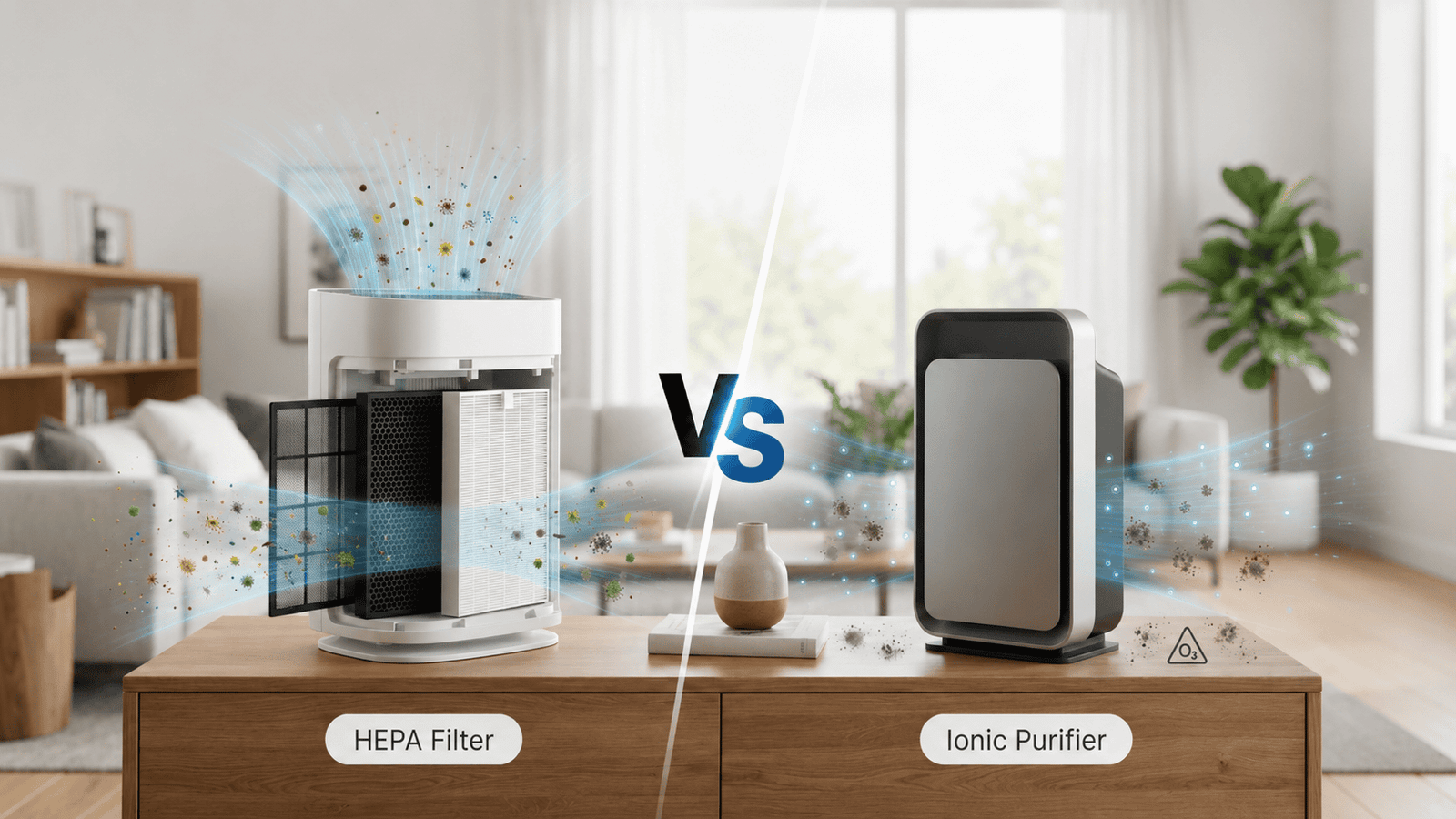
So what is an air purifier, exactly? At its core, it’s a device designed to remove pollutants dust, pollen, pet dander, odors, and more , from indoor air. But what does an air purifier do beyond that simple definition depends heavily on which technology it uses. Air purifiers generally fall into two main technologies: HEPA filtration, which physically traps particles, and ionic (or ionizing) purification, which uses charged particles to alter how airborne matter behaves.
They’re often marketed similarly both promise the best air purifier experience for cleaner air but the way they work, and their safety profiles, are genuinely different. Here’s what separates them, and how to think about finding the best air purifier for home use.
Do Air Purifiers Work? A Quick Answer
Before comparing technologies, it’s worth answering the question most people start with: does an air purifier work at all? The honest answer is that it depends on the technology and the specific model. True HEPA filtration is well-studied and reliably reduces airborne particles, while some ionic-only devices are less consistent. So “do air purifiers work” isn’t a yes-or-no question — it’s a “which kind, and how well” question, which is exactly what this guide breaks down.
How HEPA Purifiers Work
A true HEPA (High-Efficiency Particulate Air) filter works mechanically. Air is pulled through a dense filter made of fine fibers, and particles get physically trapped as they pass through. To meet the true HEPA standard, a filter must capture at least 99.97% of particles at 0.3 microns in size — a benchmark that covers dust, pollen, pet dander, mold spores, and many bacteria. This is why hepa air purifiers, and specifically air purifiers with HEPA filters, are the technology most often recommended by allergists and indoor air quality experts.
Because it’s a physical filtration process, HEPA purifiers don’t alter the air chemically. They remove particles and, when paired with an activated carbon layer, also reduce odors — but the core HEPA mechanism itself is just trapping matter as air moves through it. This mechanical simplicity is a big part of why air purifiers for allergies so often point buyers toward HEPA models specifically.
How Ionic Purifiers Work
Ionic purifiers work differently, which is the root of most air ionizer vs air purifier confusion — an ionic air purifier is still an air purifier, just one that relies on a different process than filtration alone. So what is ionizer air purifier technology, exactly? An ionic purifier releases negatively charged ions into the air, which attach to airborne particles like dust and allergens. That’s essentially what does air purifier ionizer do at a mechanical level, and it explains what is ionizer in air purifier terms: the ionizer is the component generating those charged particles. Once the purifier charges airborne particles, they become heavier. Depending on the design, the particles either fall onto nearby surfaces or clump together and collect on a charged plate inside the unit. That’s the short version of how air purifier ionizer technology works in practice.
Some ionic purifiers rely entirely on this process with no true filter at all, which means particles that settle on surfaces (rather than being captured in a plate or filter) can be stirred back into the air by movement, foot traffic, or airflow.
When people ask whether air purifier and ionizer devices are interchangeable terms, or debate air purifier or ionizer as if they’re separate product categories, this distinction — filter versus charge-based settling — is usually what they’re really asking about.
The Real Difference: What Happens to the Particles
This is the most important distinction, and it’s central to how air purifier works in each design. A HEPA filter physically removes particles from circulation — once trapped, they stay in the filter until it’s replaced. An ionizer-only purifier, in many designs, doesn’t remove particles from the room at all; it just makes them heavier so they settle out of the air and onto furniture, floors, and surfaces, where they can become airborne again.
That doesn’t mean ionic purifiers are useless — they can noticeably reduce airborne particle counts, and many ionic air purifier reviews highlight that benefit — but they don’t “capture and contain” the way a HEPA filter does.
The Safety Concern: Ozone
This is where the real difference in safety comes in. Some ionic air purifiers, particularly older or lower-quality models, generate ozone as a byproduct of the ionization process. Ozone irritates the lungs, and elevated indoor ozone levels can increase the risk of respiratory problems, especially for people with asthma or other breathing conditions.
The EPA states that ozone-generating air cleaners have not proven effective at removing indoor air pollutants at concentrations considered safe for occupied spaces. The agency also warns that these devices can pose health risks instead of providing only benefits. As a result, many consumers and experts now favor true HEPA filtration over ozone-based ionizers for indoor home use.
Not all ionic purifiers produce meaningful amounts of ozone. Some models stay below regulatory limits and carry safety certifications. However, ozone emissions remain the primary safety tradeoff to consider before buying an ionic air purifier, which is why most experts consider HEPA filtration the safer default choice.
True HEPA filtration does not carry this ozone risk, since it’s a purely mechanical process with no ionization involved.
Which One Actually Cleans Air Better?
For most households, true HEPA filtration is the more reliable and better-studied option — and it’s usually the technology behind the best home air purifiers and top air purifiers on the market.
It has a clearly defined performance standard (99.97% at 0.3 microns), removes particles from circulation rather than just settling them, and doesn’t carry an ozone risk.
Ionic purifiers can still play a role. Some hybrid units combine ionization with a true HEPA filter to improve particle capture. However, as a standalone technology, ionic purifiers generally provide less reliable air cleaning than HEPA filters. Models that produce measurable ozone also pose a genuine health concern rather than a minor tradeoff. If you’re weighing which air purifier is the best for your household, or trying to figure out what are the best air purifiers on the market this year, this is the tradeoff to keep in mind: a good air purifier prioritizes true HEPA filtration first, with ionic features as a bonus rather than the main event.
When Ionic Technology Might Still Make Sense
- As a secondary feature paired with true HEPA filtration, where the ionizer boosts particle capture without being the sole method of cleaning the air.
- In low-certified, low-ozone models specifically tested and rated below regulatory ozone limits, for buyers who want the added particle-settling effect.
If you choose an air purifier with ionic technology, make sure it includes true HEPA filtration and that the manufacturer provides ozone emission data. Reputable brands usually do — and it’s worth checking independent air purifier reviews before you buy, since specs on a box don’t always tell the full story.
Frequently Asked Questions
Are ionic air purifiers bad for you? Not inherently, but some models produce ozone as a byproduct, which is a lung irritant and a genuine health consideration, particularly for people with asthma or respiratory sensitivity. Not all ionic purifiers produce meaningful ozone, but it’s worth checking before buying one — reading ionic air purifier reviews and manufacturer ozone data is a good way to confirm this. Do ionic air purifiers work at all despite this risk? Yes, they can reduce airborne particle counts, but generally less reliably than HEPA filtration.
Is HEPA or ionic better for allergies? True HEPA filtration provides more reliable allergy relief because it physically removes pet dander, pollen, and dust from the air instead of simply causing those particles to settle onto surfaces. If allergies are your main concern, air purifiers for allergies almost always point toward HEPA-based models first.
Can I use a purifier that has both HEPA and ionic technology? Yes, and many hybrid units do combine both. As long as the ionizer is a secondary feature alongside true HEPA filtration (not the sole cleaning method) and the unit has low or certified ozone output, this combination can be effective.
How do I know if an ionic purifier produces ozone? Check the manufacturer’s specifications for ozone emission data or third-party certification. Reputable brands publish this information; if it’s absent, that’s worth treating as a red flag rather than assuming it’s safe.
What are air purifiers good for, and what are air purifiers used for? Beyond allergy relief, air purifiers are commonly used to reduce dust, pet dander, mold spores, smoke, and odors, and to support general indoor air quality for people with respiratory sensitivities, young children, or pets in the home.
What is the best home air purifier if I want one product that does it all? Look for a unit with true HEPA filtration as the primary technology, an activated carbon layer for odors, and — if it includes ionic features — verified low ozone output. That combination is generally what separates the best air purifier for home use from a purely marketing-driven pick.
Final Thoughts
HEPA and ionic purifiers solve the same basic problem — cleaner indoor air — through fundamentally different mechanisms, and that difference matters more than marketing usually suggests. True HEPA filtration is the safer, better-established default for most households, while standalone ionic purifiers carry a real ozone consideration that’s worth understanding rather than overlooking. If you want the benefits of both, look for a purifier that pairs true HEPA filtration with a low-ozone or certified ionizer, rather than relying on ionization alone. Whether you’re shopping for the best air purifiers on the market or just want a good air purifier that handles the basics well, understanding this HEPA-versus-ionic distinction is the difference between an informed purchase and a marketing-driven one.
For latest news, you can visit our blog.it our blog