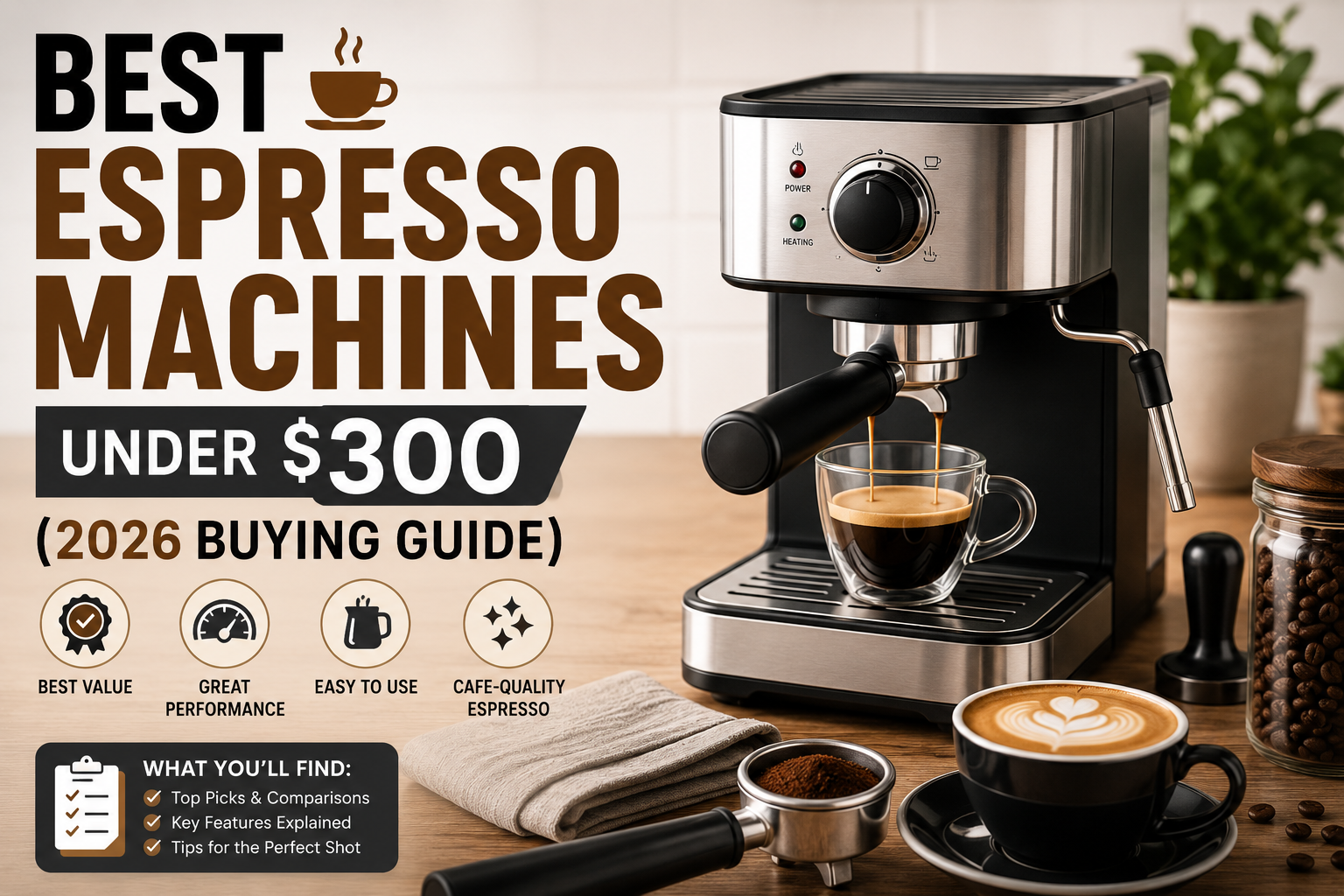
Best Espresso Machines Under $300 (2026 Buying Guide)
When it gets to $300, home espresso stops being a cheat. you go below this range, you’ll probably have to deal with plastic heaters and pressure that doesn’t stay the same. When you go above this range, you start paying for extras instead of the basics.
You can get real pump pressure, real steam wands, and sometimes PID temperature control in this price range. These are the basics of a really good shot. Spend your money here.
What Actually Matters at This Price
Before comparing machines, it helps to know which specs are worth caring about:
- Pump pressure — look for at least 9 bars; most machines in this range advertise 15, which is more than enough headroom.
- Boiler type — single-boiler machines (most of this list) need a short wait between pulling a shot and steaming milk. Dual-boiler machines avoid that wait but rarely appear under $300.
- Temperature stability — machines with PID controllers hold water temperature far more consistently than those without, which directly affects shot quality.
- Portafilter size — a 54–58mm portafilter (closer to commercial standard) generally extracts more evenly than the smaller portafilters found on entry-level machines.
If you don’t already grind fresh, pair whichever machine you choose with a burr grinder — pre-ground coffee is one of the fastest ways to waste a good espresso machine.
Best Overall: Breville Bambino
The Breville Bambino is the machine most testers land on for this price range, and it’s the more compact, lower-cost sibling of the Bambino Plus we recommend in our coffee makers under $200 guide for slightly higher budgets. It has PID temperature control and a 3-second heat-up, which is unusually fast for a machine at this price. Milk texturing is manual rather than fully automatic, which the Bambino Plus adds — a reasonable trade-off if you’re comfortable steaming milk yourself.
Best Budget Pick: De’Longhi Stilosa
The De’Longhi Stilosa is always the top choice for home baristas on a budget, and you can usually find it for well under $150, which should still leave enough money for a good grinder. It has a stainless steel boiler and a 15-bar pump. The milk frother is fully manual and takes some time to learn how to use, but the quality of the shots it makes is well worth the price.
Best for Durability and Upgradability: Gaggia Classic Pro
The Gaggia Classic Pro is the best choice if you want a machine that you could keep and change for ten years.
A commercial-style 58mm portafilter and a brass boiler are used, and it has a big enough following among home espresso fans that if you ever want to get more into the hobby, you can easily find aftermarket upgrades like PID kits and steam wand mods.
Best With a Built-In Grinder: Gevi 20 Bar
If you’d rather not buy a separate grinder right away, a Gevi model with an integrated grinder gets you a reasonable amount of value in a single box. Built-in grinders are never going to match a dedicated unit like those in our burr grinder guide, but for someone just starting out, it removes a purchasing decision and a second appliance from the counter.
Best Compact Option: De’Longhi Dedica
The De’Longhi Dedica is one of the narrowest real espresso machines on the market, so it can fit in small kitchens or apartments without sacrificing much shot quality. It delivers 15 bars of pressure in a place that isn’t too big.
Single Boiler vs. Built-In Grinder: What to Prioritize
Spend your $300 on a better machine that doesn’t have a grinder or a mid-range machine that does have one. Choose the better machine and buy an entry-level grinder separately.
The uniformity of the grind has a huge impact on the quality of the shot, but a really bad grinder will hold back even a great machine. For example, a $300 all-in-one with a weak built-in grinder will often not perform as well as a $200 machine with a separate $80 grinder.
Caring for Your Machine
Espresso machines scale up quickly if neglected, since they run hot water through narrow lines constantly. A simple maintenance routine keeps shots consistent for years — see our full coffee maker maintenance and descaling guide for a step-by-step schedule that applies to espresso machines as well as drip brewers.
Frequently Asked Questions
Do I need a separate grinder for espresso? Yes, ideally. Espresso requires a much finer and more precise grind than drip coffee, and pre-ground coffee loses freshness fast. See our burr grinder buying guide for options that handle an espresso-fine grind well.
Is a single-boiler machine a real limitation? Mostly just a workflow one. You’ll typically pull your shot first, then wait roughly 30–60 seconds for the boiler to switch to steam temperature before frothing milk. It’s a minor inconvenience, not a quality issue.
What separates a $300 machine from a $150 one? Usually temperature stability and portafilter size. PID controllers (found on machines like the Bambino) hold water temperature more precisely, and larger portafilters distribute water more evenly through the grounds.
Pair your new machine with a burr grinder for espresso-ready grind consistency, and keep it running well with our coffee maker maintenance guide.


2 comments