
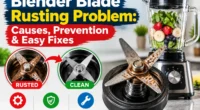
If your blender makes a grinding sound, it means that one of its moving parts is having trouble. A blender makes noise when it works, but a loud grinding, scraping, or mechanical sound usually means that there is something wrong with the motor, bearings, blades, or drive connection.
Over time, ignoring strange sounds can do more harm than good. Even something small, like a worn coupling, can put extra stress on the motor and require an expensive fix in the long run.
There are many types of blenders, such as Ninja, Vitamix, Nutribullet, Blendtec, Oster, and more. This guide will help you figure out why your blender is grinding and how to fix it.
Why Is My Blender Making a Grinding Sound?
The most common reasons include:
- Something is stuck in the blades
- Blade assembly is damaged
- Blade bearings are worn out
- Drive coupling is damaged
- Blender is overloaded
- Jar is not installed correctly
- Motor bearings are failing
- Hard objects damaged the blades
- Blender parts are worn from age
Let’s look at each cause in detail.
1. Food Is Stuck Around the Blades
One of the easiest problems to fix is food blocking the blade assembly.
Ingredients that commonly cause problems:
- Large ice cubes
- Frozen fruit chunks
- Nuts
- Seeds
- Thick mixtures
When the blades cannot rotate freely, the motor works harder and creates a grinding or straining sound.
Fix:
- Turn off the blender.
- Unplug it from the power outlet.
- Remove the jar.
- Check around the blades.
- Remove any stuck ingredients.
- Add more liquid if needed.
Avoid forcing the blender to process ingredients that are too hard or thick.
2. Damaged Blender Blade Assembly
The blade assembly is responsible for smooth rotation. If the blades become bent, loose, or damaged, they can create a grinding noise.
Common signs of blade problems:
- Grinding sound during blending
- Uneven blending results
- Excessive vibration
- Leaking from the bottom of the jar
Check the Blade:
- Does it spin smoothly?
- Are the blades bent?
- Is the blade loose?
- Is there rust or visible damage?
Solution:
Replace the blade assembly if it is damaged. Continuing to use a damaged blade can put unnecessary pressure on the motor.
3. Worn Blade Bearings
Inside many blender blade assemblies are small bearings that allow smooth rotation.
Over time, these bearings can wear out due to:
- Frequent use
- Moisture entering the assembly
- Food particles
- General wear
Symptoms:
- Grinding noise even with soft ingredients
- Blade feels rough when turned manually
- Noise increases at higher speeds
- Blade does not spin smoothly
Fix:
Most blade assemblies are replaced as a complete unit because internal bearings are usually not serviceable.
4. Damaged Drive Coupling
The drive coupling connects the motor base to the blender blade.
It transfers power from the motor to the blades.
A worn coupling can cause:
- Grinding or clicking sounds
- Blades slowing down
- Poor blending performance
- Intermittent operation
How to Check:
Look at the connection points:
- The gear on the motor base
- The coupling underneath the jar
If the teeth look worn or damaged, replacement may be required.
5. Blender Is Overloaded
A blender can make a grinding sound when the motor is under too much stress.
This commonly happens when blending:
- Ice without enough liquid
- Frozen ingredients
- Thick sauces
- Large quantities
Fix:
Try:
- Adding more liquid
- Reducing the amount of ingredients
- Cutting food into smaller pieces
- Using pulse mode first
A blender needs enough space for ingredients to move around the blades.
6. Blender Jar Is Not Locked Properly
A jar that is not correctly installed can create unusual sounds because the blade connection is not aligned properly.
Signs:
- Grinding starts immediately
- Blender shakes
- Jar moves during operation
- Noise stops when the jar is removed
Fix:
- Remove the jar.
- Clean the connection area.
- Align the locking tabs.
- Secure the jar properly.
This is a common issue with many personal blenders and high-speed models.
7. Motor Bearing Problems
If the grinding sound is coming from the blender base instead of the jar, the motor may have worn bearings.
Signs of motor bearing failure:
- Grinding noise without ingredients
- Burning smell
- Excessive vibration
- Motor getting hot quickly
- Reduced blending power
Solution:
Motor bearing problems usually require professional repair or motor replacement.
8. Hard Objects Have Damaged the Blender
Blenders are powerful, but they are not designed to crush every type of material.
Objects that can damage blades:
- Metal spoons
- Very hard frozen items
- Fruit pits
- Non-food objects
Fix:
Inspect:
- Blade edges
- Jar bottom
- Blade rotation
Replace damaged parts before using the blender again.
9. Blender Is Old and Components Are Worn
After years of use, several parts may begin wearing out:
- Blade assembly
- Coupling
- Bearings
- Motor components
An older blender may start showing multiple symptoms:
- Grinding sounds
- Less power
- Overheating
- Frequent stopping
At this stage, replacing worn parts or upgrading the blender may be more practical.
Blender Making Grinding Noise but Still Works
If your blender still operates but makes a grinding sound, do not ignore it.
The blender may continue working temporarily, but the damaged component can worsen.
Check:
- Blade assembly
- Drive coupling
- Bearings
- Motor base
Fixing a small problem early can prevent motor damage.
Blender Making Grinding Noise When Empty
A blender should run smoothly without ingredients.
If it makes a grinding sound while empty, possible causes include:
- Damaged blade bearings
- Worn coupling
- Motor bearing failure
- Loose internal parts
This usually indicates a mechanical problem rather than an ingredient issue.
How to Prevent Blender Grinding Problems
Follow these simple maintenance tips:
Do Not Overfill the Blender
Stay below the maximum fill line.
Add Liquid First
Liquid helps ingredients move easily and reduces motor stress.
Clean the Blade Area
Food buildup can affect blade movement.
Avoid Hard Objects
Only blend ingredients recommended by the manufacturer.
Replace Damaged Parts Early
Small problems can become expensive repairs if ignored.
When Should You Replace Your Blender?
Consider replacing your blender if:
- The motor makes a loud grinding sound
- It smells burnt
- It vibrates excessively
- Replacement parts are unavailable
- Repair costs are close to a new blender price
Final Thoughts
A blender making a grinding sound is usually caused by a problem with the blade assembly, drive coupling, overload, or motor components.
Start with simple solutions:
- Remove stuck ingredients
- Check the blade condition
- Reinstall the jar correctly
- Reduce heavy loads
If the grinding noise continues even when the blender is empty, the issue may require replacement parts or professional repair.
Proper maintenance and careful use can help your Ninja, Vitamix, Nutribullet, or other blender run smoothly and last longer.
Related Articles:








1 comment