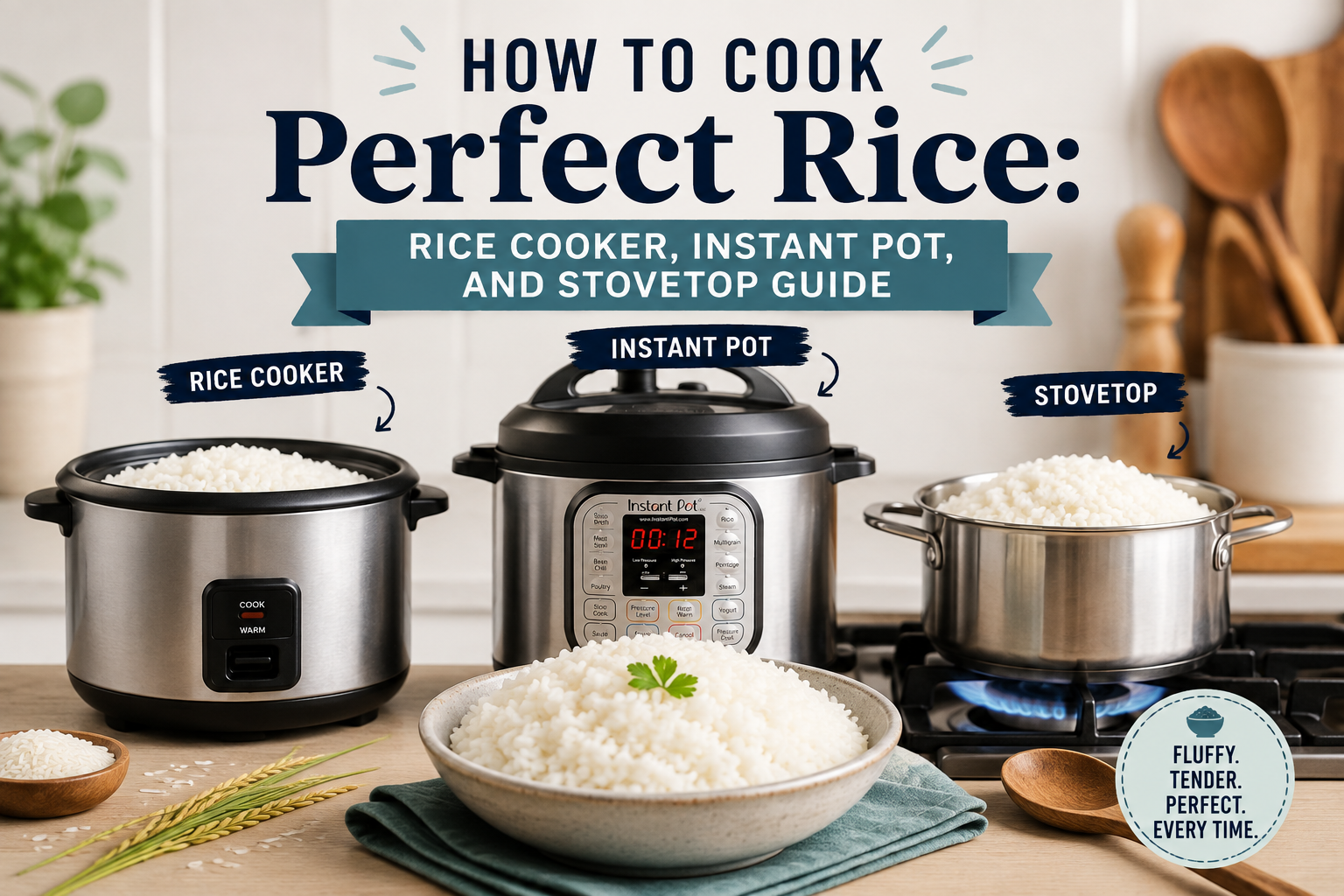

Rice seems like it should be simple, and it is — once you know the ratio and timing for your specific method. This guide covers how a rice cooker actually works, the water-to-rice ratio that gets it right every time, how long rice takes depending on the appliance, and how to make rice in an Instant Pot if that’s what you have on hand.
Quick answer: For white rice in a rice cooker, use a 1:1 ratio of rice to water (1 cup rice to 1 cup water), and it will take about 25–30 minutes including the automatic keep-warm switch. For an Instant Pot, use the same 1:1 ratio with a 3–4 minute cook time on high pressure plus a natural release.
What Is a Rice Cooker?
A rice cooker is a countertop appliance built to cook rice automatically, without needing to watch the stove or guess when the rice is done. You add rice and water in the right ratio, press start, and the machine handles the rest — heating, boiling, simmering, and switching itself off (or to “keep warm”) once the rice is cooked.
How Does a Rice Cooker Work?
Rice cookers work using a simple but clever piece of engineering: a temperature sensor. Here’s how do rice cookers work in practice —
- The inner pot heats water and rice to a boil, just like a pot on the stove.
- As the rice absorbs water, the temperature inside the pot stays right around 212°F (100°C) — the boiling point of water — because the water hasn’t fully evaporated yet.
- Once the water is fully absorbed, the temperature in the pot starts to rise above boiling point, since there’s no more moisture left to keep it capped at 212°F.
- The rice cooker’s internal thermostat detects that temperature spike and automatically switches from “cook” to “warm,” shutting off active heating.
That’s the entire mechanism — no timer, no guesswork, just a sensor reacting to the physical reality that rice pulls the temperature down until the water’s gone. This is also why rice cooker water ratio matters so much: too much water and the machine keeps cooking longer than it should trying to boil it off; too little and it can click over to “warm” before the rice is actually done.
Rice Cooker Water Ratio
The white rice to water ratio in a rice cooker is the single most important variable in getting good rice. The standard starting point:
1 cup white rice : 1 cup water
This is a 1:1 ratio by volume, and it works for most standard long-grain and medium-grain white rice. Some variations depending on rice type:
| Rice Type | Rice to Water Ratio |
|---|---|
| White long-grain | 1 : 1 |
| White medium-grain | 1 : 1 to 1 : 1.1 |
| Jasmine rice | 1 : 1 |
| Basmati rice | 1 : 1.25 |
| Brown rice | 1 : 1.5 to 1 : 2 |
| Sushi rice | 1 : 1.1 |
Most electric rice cookers also have ratio markings printed directly on the inside of the pot — fill rice to the numbered line, then fill water to the matching line, which is a faster way to get the proportion of rice to water right without measuring cups.
A quick tip on rinsing: rinse white rice under cold water until it runs mostly clear before cooking. This removes surface starch that would otherwise make the rice gummy, and it doesn’t change the water ratio — rinse, drain well, then add the same 1:1 water measurement.
How Long Does Rice Take in a Rice Cooker?
Rice cooker cooking time depends on the type of rice and the size of the batch, but here’s what to expect:
| Rice Type | Approximate Cook Time |
|---|---|
| White rice | 25–30 minutes |
| Jasmine rice | 25–30 minutes |
| Basmati rice | 25–35 minutes |
| Brown rice | 45–60 minutes |
| Sushi rice | 30–35 minutes |
These times include the machine’s automatic cycle from boil to absorption to the “keep warm” switch. Larger batches take slightly longer since there’s more water to bring to a boil initially, but the ratio and general timing stay roughly the same.
How to Use a Rice Cooker (Step by Step)
Rice cooker how to use, broken down simply:
- Measure your rice. Use the cup that came with your rice cooker if it has one — many rice cooker cups are slightly smaller than a standard measuring cup, but the ratio still works because the accompanying water-line markings are calibrated to match.
- Rinse the rice under cold water until the water runs mostly clear, then drain well.
- Add rice to the inner pot, then add water — either 1:1 by cup measurement, or up to the corresponding water line marked in the pot.
- Close the lid and press start (or select the appropriate rice setting if your cooker has multiple modes).
- Let it finish automatically. The cooker will switch to “keep warm” on its own.
- Let it rest for 5–10 minutes after it switches to warm, lid closed, before fluffing. This lets the moisture redistribute evenly through the grains.
- Fluff with a rice paddle or fork and serve.
How to Prepare Perfect Rice: A Few Extra Tips
- Don’t lift the lid while it’s cooking. Every time you open it, steam escapes and the internal temperature drops, which throws off the sensor’s timing.
- Let it rest before fluffing. Skipping the rest period is one of the most common reasons rice turns out wet or clumpy on the bottom.
- Adjust water slightly for older rice. Rice that’s been stored a long time is drier and may need a touch more water — closer to 1:1.1 instead of a flat 1:1.
- Salt and oil are optional, not required. A rice cooker doesn’t need seasoning to cook properly, but a small pinch of salt or splash of oil before cooking can improve flavor and texture.
Can You Cook Rice in an Instant Pot?
Yes — Instant Pot rice is one of the most common things people make in a pressure cooker, and it’s arguably faster than a dedicated rice cooker once you factor in pressurizing time.
White Rice Instant Pot Method
Ratio: 1 cup white rice to 1 cup water (same 1:1 ratio as a rice cooker)
Instant Pot rice recipe steps:
- Rinse rice until the water runs mostly clear, then drain.
- Add rice and water to the Instant Pot insert in a 1:1 ratio.
- Add a small pinch of salt if desired.
- Close the lid, set the valve to sealing, and cook on high pressure for 3–4 minutes.
- Let the pressure release naturally for 10 minutes, then release any remaining pressure manually.
- Fluff with a fork and serve.
The natural release step matters — releasing the pressure immediately can leave the rice slightly underdone or gummy, since it hasn’t had time to finish steaming in that residual heat.
Rice Cooker vs. Instant Pot for Rice
| Rice Cooker | Instant Pot | |
|---|---|---|
| Active cook time | 25–30 min | 3–4 min pressurized + ~10 min release |
| Hands-off | Yes | Yes |
| Best for | Dedicated, no-fuss rice duty | If you don’t own a separate rice cooker |
| Keep-warm function | Built-in, automatic | Available but less precise |
If you already own a rice cooker, it’s generally the more convenient option purely because it’s a single-purpose appliance you can set and forget. If you only have an Instant Pot, it does the job just as well.
Stove Top Rice Cooker Method
If you don’t have an electric rice cooker or Instant Pot, a regular pot on the stove works fine using the same fundamentals:
- Combine 1 cup rinsed rice with 1 to 1.5 cups water in a pot with a tight-fitting lid (slightly more water than an electric cooker, since some evaporates as steam on the stovetop).
- Bring to a boil uncovered.
- Once boiling, reduce heat to low, cover, and simmer for 15–18 minutes without lifting the lid.
- Remove from heat and let it rest, covered, for 5–10 minutes.
- Fluff with a fork and serve.
Frequently Asked Questions
How long does rice take to cook in a rice cooker? White rice typically takes 25–30 minutes in an electric rice cooker, including the machine’s automatic switch to keep-warm. Brown rice takes longer, usually 45–60 minutes, because the outer bran layer takes more time to absorb water.
What is the correct rice cooker water ratio? For most white rice, use a 1:1 ratio — 1 cup rice to 1 cup water. Basmati rice needs slightly more water (around 1:1.25), and brown rice needs closer to 1:1.5 or 1:2.
How does a rice cooker know when rice is done? It uses a thermostat that detects when the pot’s internal temperature rises above the boiling point of water (212°F). While water is still present, the temperature can’t exceed that point — once it does, all the water has been absorbed, signaling the rice is finished.
Can you cook rice in an Instant Pot instead of a rice cooker? Yes. Use the same 1:1 rice-to-water ratio, cook on high pressure for 3–4 minutes, then let the pressure release naturally for about 10 minutes before opening.
Why is my rice mushy or gummy even with the right ratio? This is usually from not rinsing the rice beforehand (leftover surface starch causes gumminess) or from skipping the resting period after cooking, which lets excess surface moisture redistribute.
Final Thoughts
Cooking good rice comes down to two things: the right water ratio for the type of rice you’re using, and letting the appliance — rice cooker, Instant Pot, or stovetop — finish its full cycle without interruption. Once you’ve got the 1:1 ratio down for white rice, it becomes one of the easiest things you can make on repeat with zero variation in results.







