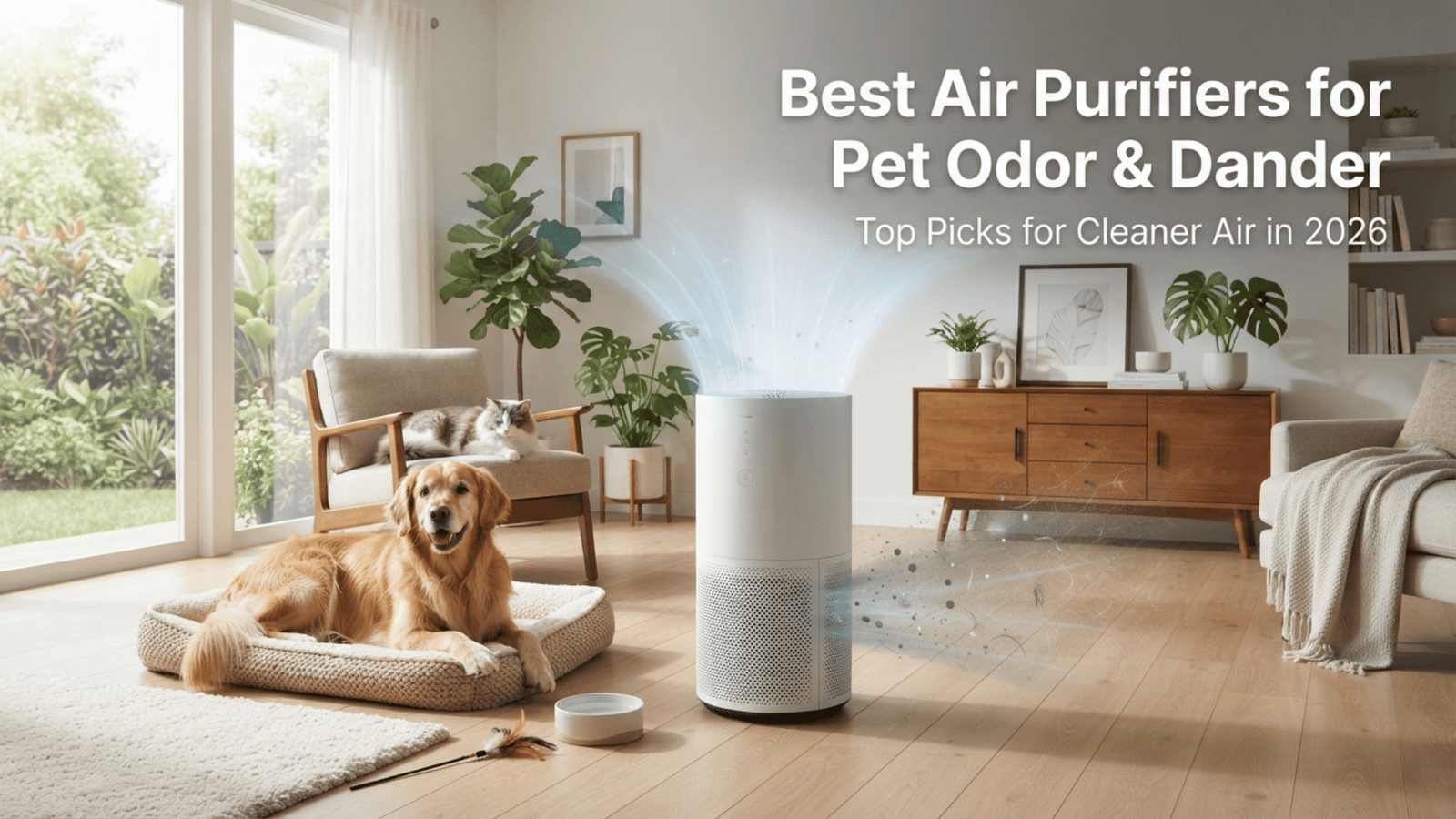
Pet owners often face a unique set of air quality issues that aren’t typically addressed by standard air purifiers. These include smells that don’t go away (from things like litter boxes, wet fur, or accidents), allergens in the form of fine dander, and a constant flow of hair and fur that floats around. Those three factors aren’t always considered in “best air purifier” rankings. Here’s how to find the best pet purifier.
What to Look For in a Pet-Focused Air Purifier
True HEPA filtration. Pet dander particles are extremely small — often under 2.5 microns — so a purifier needs a true HEPA filter (captures 99.97% of particles at 0.3 microns), not a “HEPA-type” or “HEPA-like” filter, which is a marketing term for a lower-grade filter that won’t perform the same.
A substantial activated carbon layer. HEPA filters trap particles, but they don’t remove odor. Since typical purifiers’ carbon layers are too thin to control litter box or wet-dog smell, check for purifiers with a “pet” or “odor” specific carbon filter.
CADR rated for your actual room size. CADR (Clean Air Delivery Rate) tells you how much air the unit can filter per hour. As a simple rule of thumb, look for a smoke CADR that’s at least two-thirds of your room’s square footage, and go higher if you have multiple pets or the purifier will run in a smaller, enclosed room like a litter box area.
Pre-filters that catch hair before it clogs the HEPA filter. If no washable pre-filter catches pet hair, an expensive HEPA filter can wear out quickly.
Best Overall: Large HEPA + Carbon Combo Purifiers
For most households with pets, a purifier with a large true HEPA filter paired with a dedicated high-capacity carbon filter is the most reliable combination — it handles dander, hair, and odor in one pass rather than specializing in just one. These typically fit medium to large living rooms and run quietly enough for all-day use.
Best for Strong Odor: Purifiers With Pet-Specific Carbon Filters
If odor (not just dander or hair) is your main problem — think litter boxes or multi-pet households — prioritize a purifier with a filter explicitly labeled for pet or odor use, since these use a thicker, more saturated carbon layer built specifically to adsorb ammonia and other pet-related odor compounds that a standard carbon filter struggles with.
Best for Small Spaces: Compact HEPA Purifiers
For bedrooms, litter box corners, or apartments, a compact true HEPA purifier sized correctly for the room (rather than an oversized unit running on low, or an undersized one running maxed out) will outperform a bigger unit that’s mismatched to the space. Compact doesn’t mean weak — just make sure the CADR still matches the square footage.
Best Budget Option: True HEPA Without Smart Features
If you don’t need app control or air quality sensors, skipping the “smart” features and buying a true HEPA + carbon purifier without the extras is the most cost-effective way to get real pet-odor performance without paying for functionality you won’t use.
What to Avoid
- Ionic-only purifiers for pet odor — they can help with some airborne particles but don’t have carbon filtration, so they’re weak on the odor side, which is usually the primary complaint pet owners have.
- “HEPA-type” filters — this labeling is a common way manufacturers market filters that don’t meet true HEPA standards, and it directly affects how well dander is captured.
- Undersized units in odor-heavy rooms — a purifier that’s too small for the room will run constantly on high and still fall behind, especially in litter box areas.
Frequently Asked Questions
Do air purifiers actually help with pet odor? Yes, but only if they include a substantial activated carbon filter. HEPA filtration alone captures particles like dander and hair but doesn’t remove odor — carbon is what adsorbs odor-causing compounds.
What CADR do I need for pet odor and dander? As a general guideline, aim for a smoke CADR at least two-thirds of your room’s square footage, and size up if you have multiple pets, a litter box in the room, or poor ventilation.
Is a bigger air purifier always better for pets? Not necessarily. An oversized purifier in a small room can be overkill, while an undersized one in a large room will run constantly without keeping up. Match CADR to your actual room size rather than buying the largest unit available.
How often should I replace filters in a home with pets? Pet hair and dander clog filters faster than average use, so expect to replace HEPA and carbon filters more frequently than the manufacturer’s standard timeline — check filters monthly and replace based on visible buildup rather than relying solely on a fixed schedule.
Final Thoughts
The proper pet air purifier must have real HEPA filtration for dander and hair and a large activated carbon filter for odor.. Skimping on either one leaves half the problem unsolved. Match the CADR to your room size, prioritize pet-specific carbon filters if odor is your main issue, and you’ll get noticeably better results than a generic “best air purifier” pick that wasn’t built with pets in mind.