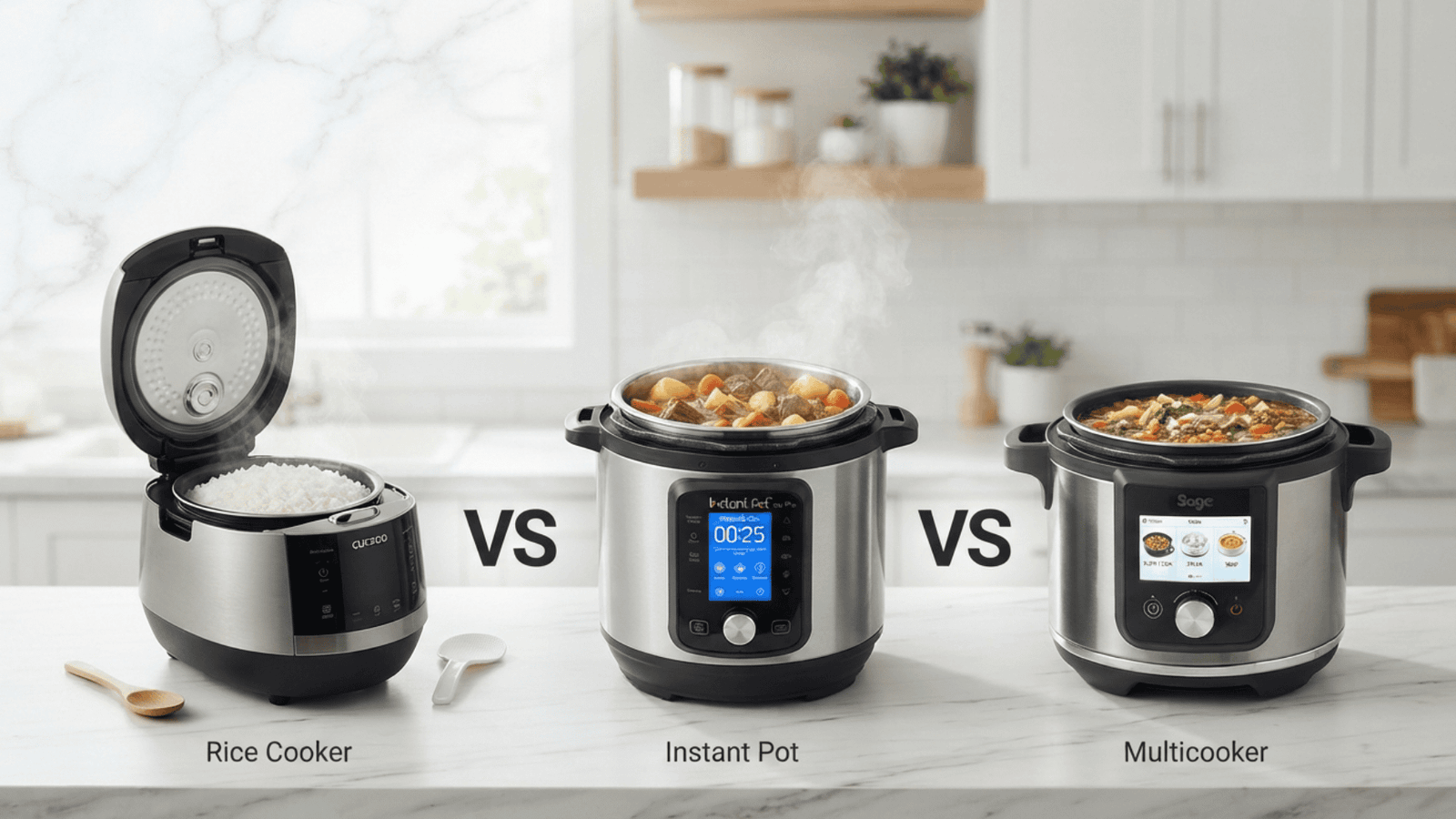
These three gadgets are sometimes grouped together because they all cook rice, sit on the counter, and promise to simplify dinner. But they’re built around different priorities, and picking the wrong one for your habits means either overpaying for features you won’t use or ending up frustrated with results that don’t match what you expected. Here’s how they actually differ.
The Short Answer
- Buy a dedicated rice cooker if rice (or grains generally) is a daily staple and you want consistent, hands-off results every time.
- Buy an Instant Pot if you want one appliance that pressure cooks, sautés, steams, and makes rice reasonably well as a secondary function.
- Buy a multicooker if you want something in between — broader functionality than a rice cooker, but simpler and often cheaper than a full pressure-cooking system.
How Each One Actually Works
Rice cookers are single-purpose by design. Basic models use a simple heat sensor that shuts off or switches to “keep warm” once the water is absorbed. Higher-end models add fuzzy logic or induction heating, which adjusts time and temperature based on the type and amount of rice, producing more consistent texture across white, brown, sushi, and other grain types.
Instant Pots are electric pressure cookers with rice as one function among many — pressure cooking, slow cooking, sautéing, steaming, yogurt-making, and more, depending on the model. The rice setting works by pressure-cooking rather than the slow steam-absorption method a rice cooker uses, which changes both the cook time and, for some rice types, the final texture.
Multicookers sit between the two. They typically combine several functions — rice, slow cook, steam, sauté, sometimes light pressure cooking — without going as deep into any single one as a dedicated appliance would. Think of them as a generalist appliance built around convenience rather than specialization.
Rice Quality: Where the Real Difference Shows Up
This is the category where people are most often surprised. A dedicated rice cooker, especially one with fuzzy logic, is built to nail texture specifically — it’s slower by design, and that slowness is what produces even, properly hydrated grains.
An Instant Pot’s pressure-cooking method cooks rice faster, but the texture can come out slightly different — sometimes softer or more prone to clumping, particularly with more delicate rice types like jasmine or basmati, since pressure cooking wasn’t originally designed around rice’s specific hydration needs. It’s a solid convenience option, but a rice-specific appliance still tends to produce more consistent results across rice types.
Multicookers land in the middle: closer to true rice-cooker quality than an Instant Pot on the rice setting, but usually a step behind a dedicated high-end rice cooker with fuzzy logic.
Bottom line: if rice quality specifically is your top priority, a dedicated rice cooker still wins. If rice is just one of several things you want the appliance to do well, an Instant Pot or multicooker is a reasonable tradeoff.
Versatility
This is the Instant Pot’s strongest argument. A single Instant Pot can replace a pressure cooker, slow cooker, steamer, and rice cooker for most households, which matters a lot in smaller kitchens or for anyone trying to consolidate counter space. Multicookers offer a similar pitch with fewer functions but usually at a lower price point and a gentler learning curve. Rice cookers, by contrast, do one thing and don’t try to do more.
Ease of Use
Rice cookers are the simplest of the three — add rice, add water, press start, and walk away. There’s minimal setup and almost no learning curve.
Instant Pots have more of a learning curve, particularly around pressure release methods (natural vs. quick release) and adjusting cook times for different ingredients. Once you’re comfortable with it, it’s fast and reliable, but the first few uses often involve a recipe or manual close at hand.
Multicookers typically fall in between — more settings than a rice cooker, but without the pressure-release complexity of an Instant Pot.
Price
Basic rice cookers are generally the least expensive of the three, with high-end fuzzy logic or induction models costing more, sometimes approaching multicooker or Instant Pot pricing. Multicookers and Instant Pots tend to sit in a similar range, with pricing driven more by size and function count than by brand.
Which One Should You Buy?
Get a rice cooker if:
- Rice or grains are a near-daily part of your meals
- You want the most consistent possible texture, especially with brown rice or specialty grains
- You’d rather have one simple appliance that does its job perfectly than one that does many things adequately
Get an Instant Pot if:
- You want to consolidate multiple appliances into one
- You’re comfortable with a bit of a learning curve for the versatility payoff
- Rice is only one of several things you’ll use it for regularly
Get a multicooker if:
- You want more functionality than a rice cooker without the complexity of pressure cooking
- You’re cooking for a household where convenience matters more than rice being restaurant-perfect
- Budget and counter space are both a consideration
Frequently Asked Questions
Can an Instant Pot replace a rice cooker completely? It can for most casual cooking, but if rice is a daily staple in your house, a dedicated rice cooker — especially a fuzzy logic model — will generally produce more consistent texture across different rice types than an Instant Pot’s pressure-cook setting.
Is a multicooker basically the same as an Instant Pot? Not exactly. Multicookers usually offer a similar range of functions but with less emphasis on pressure cooking specifically, which makes them simpler to use but less versatile for pressure-cooking-specific recipes like dried beans from scratch.
Do I need both a rice cooker and an Instant Pot? If you cook rice frequently and also want pressure-cooking versatility for other meals, owning both isn’t redundant — they solve different problems well. If you have limited counter space or a limited budget, choose the appliance that matters most for your everyday cooking.
Which is easiest to clean? Rice cookers are generally the simplest to clean, especially models with a nonstick inner pot. Instant Pots and multicookers have more components (sealing rings, valves, lids) that need regular attention to avoid odor retention or wear.
Final Thoughts
There’s no universal winner here — the right choice depends on how central rice is to your cooking and how much you value having one appliance handle multiple jobs. If rice quality and simplicity matter most, a dedicated rice cooker is still the more reliable choice. If you want one machine that covers more ground, an Instant Pot or multicooker will get you there, with a small tradeoff in rice-specific consistency.