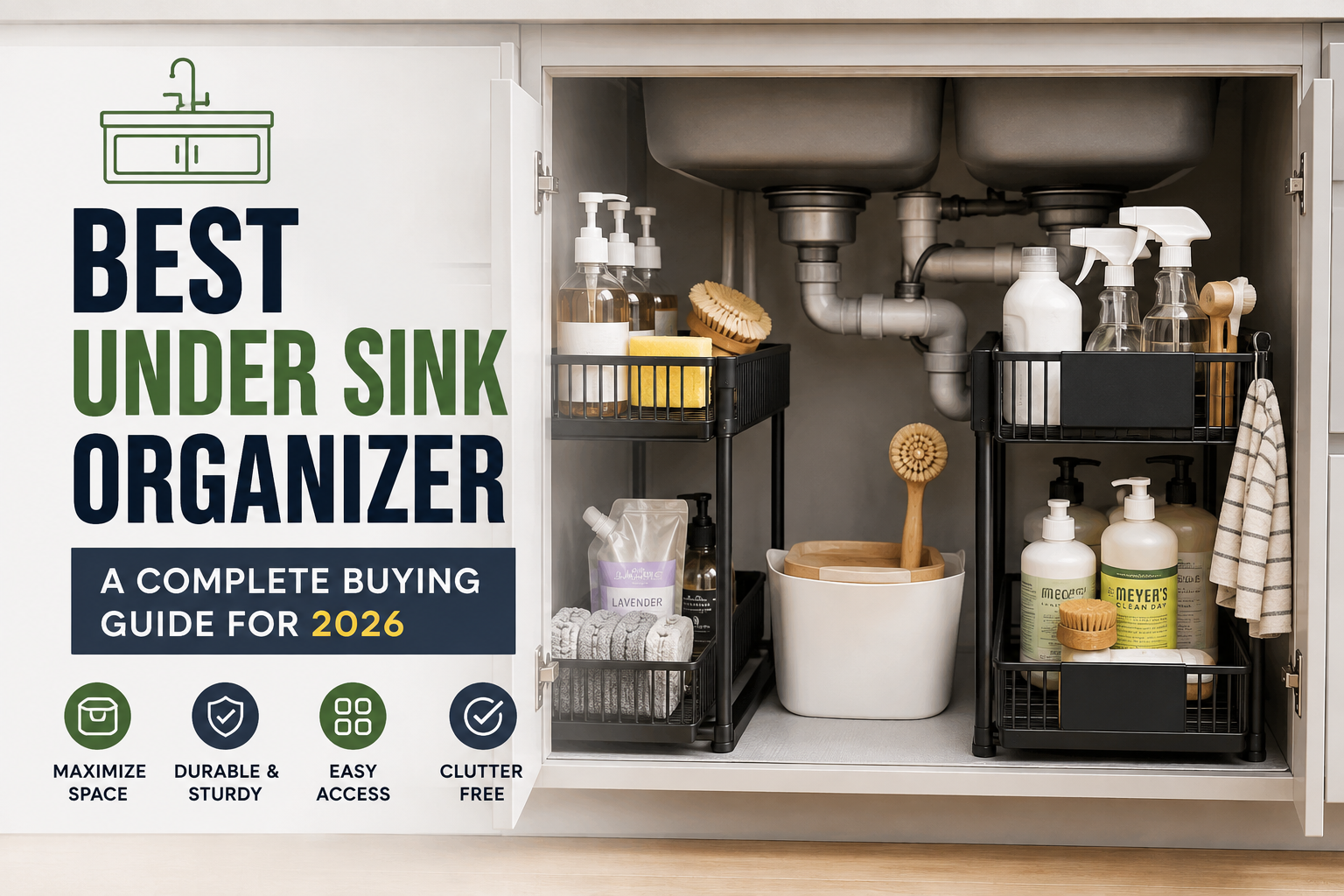

One of the most uncomfortable places in your house is beneath the sink in your kitchen or bathroom. Despite having pipes running through the center and an unusual height, it manages to be filled with garbage bags, cleaning sprays, sponges, and that one bottle of drain cleaner you forgot you had. An effective under-sink organizer transforms that disarray into a useful system.
This guide breaks down the best types of under sink organizers, what to look for before you buy, and how to pick the right one for your space. If you’re also tackling other problem areas in your home, our Best Under-Sink Organizer for an RV or Tiny Bathroom and Under-Sink Organizer vs. Pull-Out Cabinet Shelf are good next reads.
Why Under Sink Storage Is So Hard to Get Right
Most cabinets are simple rectangles. Under sink cabinets are not. You’re working around:
- The plumbing. Pipes, shut-off valves, and sometimes a garbage disposal eat into usable width and depth.
- Awkward height. There’s often a tall, empty gap above your bottles that a fixed shelf can’t use.
- Moisture. Sinks leak, drip, and sweat, so anything you store down there should tolerate some dampness.
- Mixed items. Tall spray bottles, flat sponges, bulky trash bags, and small brushes all need different kinds of space.
The right organizer solves for all four at once, which is why a single flat shelf usually isn’t enough on its own.
Types of Under Sink Organizers (And When to Use Each)
1. Pull-Out Sliding Drawers
You don’t have to kneel and reach into the dark rear corner of the cabinet because these are mounted on rails and slide out toward you. They are the ideal choice if you store heavier objects, such as large detergent jugs, or if your cabinet is deep. Many may be adjusted to fit around a pipe in the middle.
Best for: Deep cabinets, kitchens, heavier bottles.
2. Two-Tier Expandable Shelves
These add a second shelf on top of the one you already have, making the room you have grow upward instead of outward. Most can be stretched or shrunk to fit different cabinet sizes, and they have a U-shaped cutout that lets them fit over pipes.
Best for: Cabinets with tall, wasted vertical space; anyone who wants a quick, low-cost upgrade.
3. Tension Rod / Hanging Systems
You can hang spray bottles by their trigger handles on a horizontal tension rod. This makes the floor of the cabinet available for bins and boxes. This is one of the best ways to make small areas bigger.
Best for: Small cabinets, spray bottle overload, renters (no drilling required).
4. Lazy Susans / Turntables
You don’t have to dig to see things when you use a rotating tray. Round turntables work well in corner cabinets or cabinets that don’t have a pipe in the middle that gets in the way of turning.
Best for: Cabinets without a center obstruction, small item storage (like cleaning pods or extra sponges).
5. Door-Mounted Racks
These go on the inside of the cabinet door and can hold small, light things like trash bags, scrub brushes, or gloves. They make storage space bigger without taking up any floor room.
Best for: Maximizing capacity, storing small or lightweight items, pairing with a floor-based system.
6. Modular Bin and Caddy Systems
Bins that stack or connect let you group things by type (like dishes, bathroom items, or tools) and take out the whole bin at once instead of taking things out one by one.
Best for: Households that want grab-and-go organization, shared bathrooms, families.
If you’re not sure which type fits your cabinet, our step-by-step guide to measuring cabinet space walks through it before you buy anything.
What to Look For Before You Buy
- Pipe clearance. Measure the width on either side of your pipes, not just the total cabinet width. Look for organizers with an adjustable or U-shaped cutout.
- Material. Look for rust-resistant metal, water-resistant coated wire, or BPA-free plastic, since moisture is a given under any sink.
- Weight capacity. Cleaning bottles are heavier than they look — check the listed capacity if you’re using a pull-out drawer or shelf.
- Adjustability. Expandable or modular systems adapt better over time than fixed-size units, especially if you switch cleaning products often.
- Ease of cleaning. Removable trays or bins make it much easier to wipe up spills and leaks.
How to Set Up Your Under Sink Cabinet (Step by Step)
- Empty the cabinet completely and wipe it down, checking for any signs of a slow leak.
- Measure width, depth, and pipe clearance on both sides before ordering anything.
- Start with the vertical space. Add a two-tier shelf or hanging rod first, since this is usually the most wasted space.
- Add door storage for small, light items to keep the floor clear.
- Group remaining items into bins or a pull-out drawer by category — cleaning, dishwashing, spares.
- Keep heavier items low and to the sides, away from the center pipe, for the most stable footprint.
For a broader decluttering approach that goes beyond the sink, check out our complete home organization checklist.
Frequently Asked Questions
Do I need to drill holes to install an under sink organizer? No. Most options — tension rods, two-tier shelves, pull-out drawers, and bin systems — are freestanding or tension-mounted, which makes them renter-friendly.
What’s the best organizer for a cabinet with a center pipe? Two-tier expandable shelves and pull-out drawers with adjustable, U-shaped cutouts handle a center pipe better than solid turntables or rigid single-piece shelves.
How do I stop things from getting wet under the sink? Use a waterproof liner or tray at the base of the cabinet, and choose organizers made of rust-resistant or water-resistant materials so a small drip doesn’t ruin your storage.
Can I use the same type of organizer in the kitchen and bathroom? Yes, though bathroom cabinets are often shallower, so tension rods, door racks, and small bins tend to fit better than deep pull-out drawers.
Final Thoughts
There’s no single “best” under sink organizer — the best one is the one that matches your cabinet’s shape, your pipe layout, and what you’re actually storing. Start by using the vertical space you’re wasting, add door storage for small items, and group what’s left into bins or a pull-out drawer. Once it’s set up, it takes just a minute to keep tidy.
Looking for more room-by-room fixes? Browse our full 7 Under-Sink Organizers That Actually Fit Small Kitchens for tips on every space in your home.
Read More Articles







