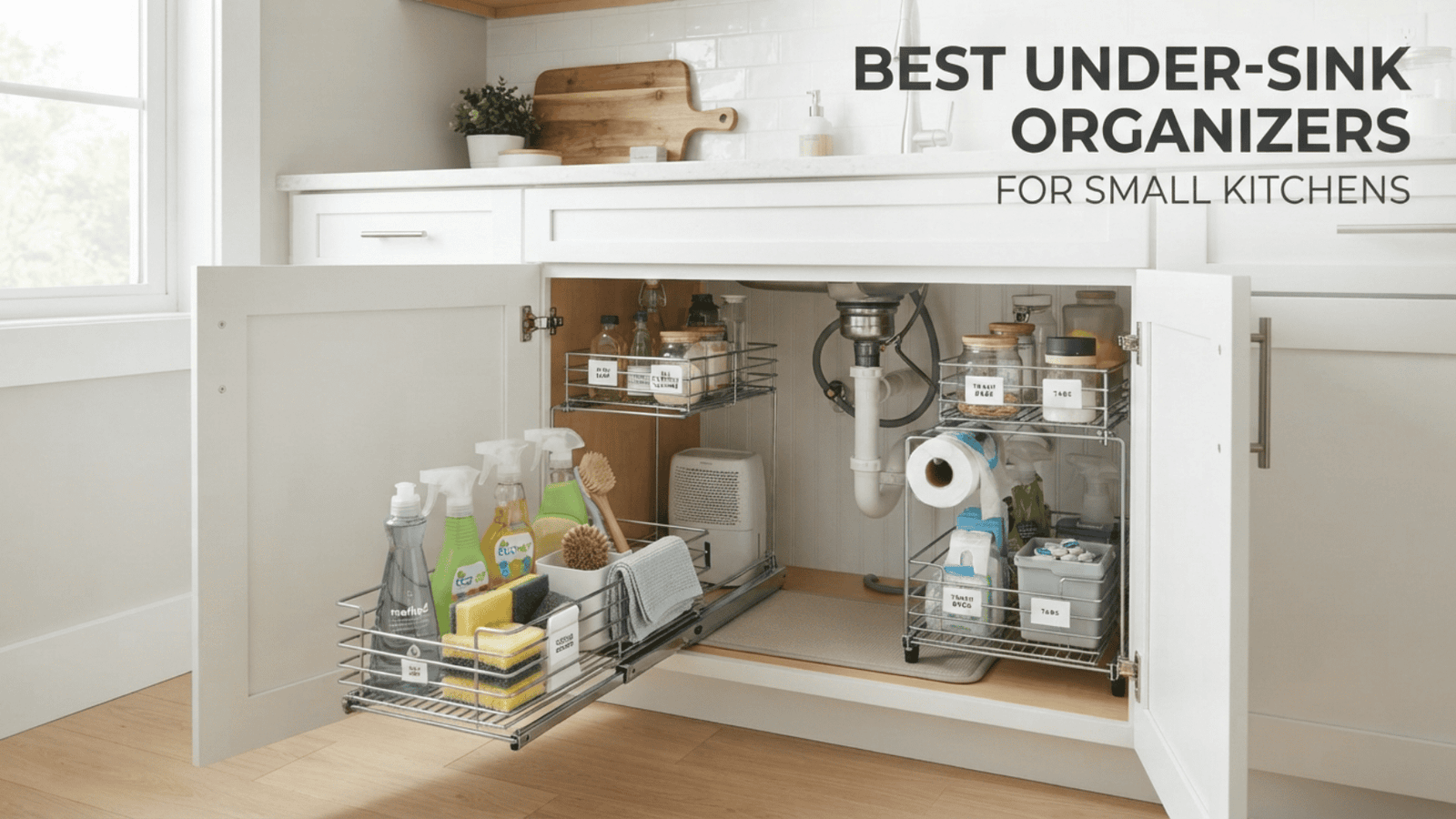
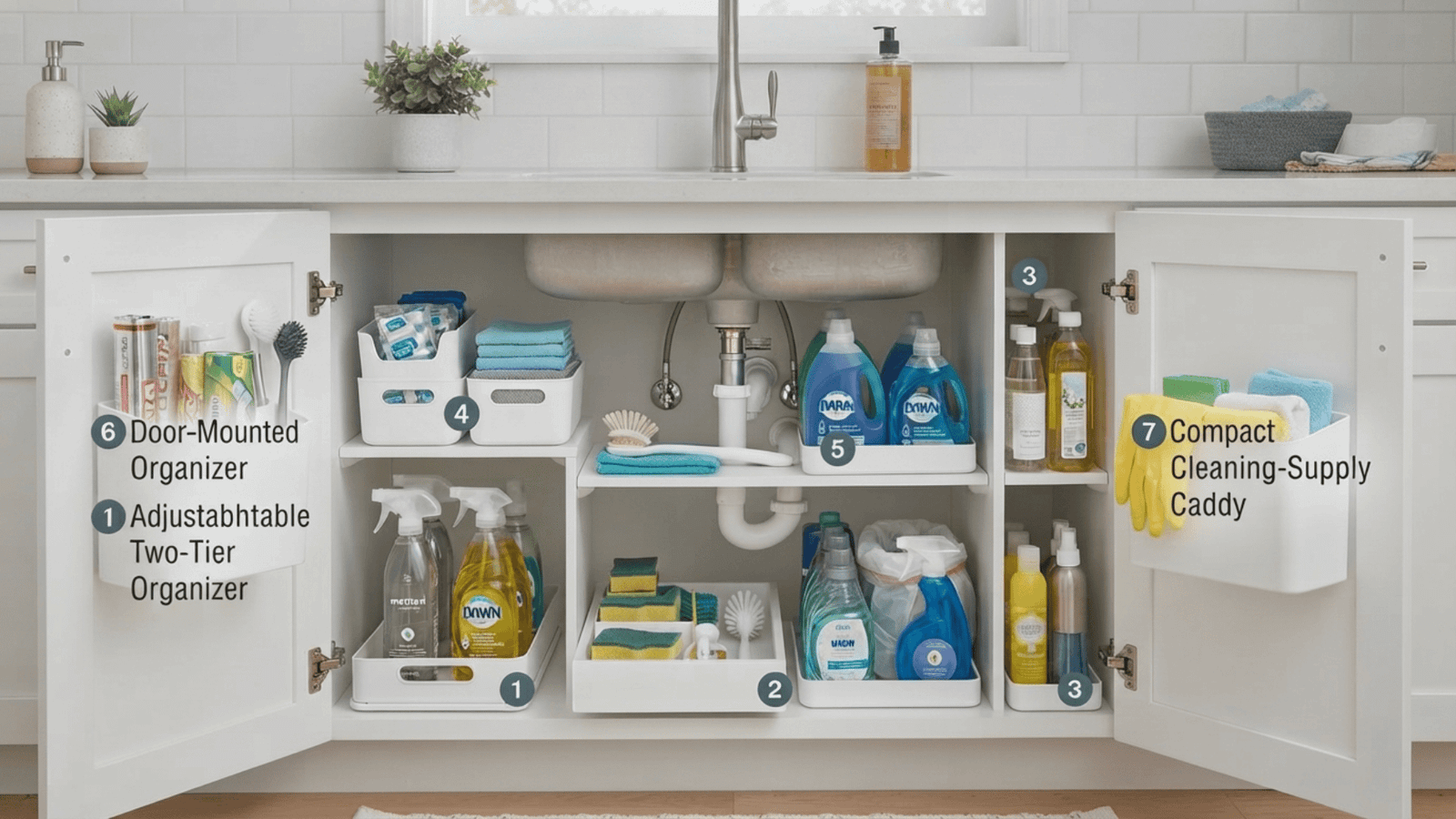
The cabinet under your kitchen sink is one of the most awkward storage spaces in the house. A drainpipe cuts through the middle, the space is often shallow, and bottles and cleaning supplies end up in a pile the moment you close the door. In a small kitchen, that wasted space matters even more — you don’t have a pantry or extra cabinet to fall back on.
An under-sink organizer fixes this by working around the pipe instead of ignoring it, giving you usable, stackable storage in a space that’s normally just a junk pile. Here’s what to check before buying one, and three options worth considering for small kitchens.
Why Under-Sink Storage Is Different From Regular Cabinet Storage
A standard cabinet organizer assumes a flat, uninterrupted floor. Under the sink, you’re working around:
- The drainpipe, which usually sits toward the back-center of the cabinet
- A shallower usable depth than the cabinet’s actual measurements suggest, once you account for the pipe and any shutoff valves
- Uneven height if there’s a garbage disposal or in-sink filtration unit taking up part of the space
Because of this, generic shelving or bins often don’t fit well. Purpose-built under-sink organizers are designed with a gap, adjustable width, or split footprint specifically to work around plumbing.
What to Check Before You Buy
1. Measure around the pipe, not just the cabinet. Measure the width on either side of the drainpipe separately, plus the depth from the cabinet door to the back wall. Many under-sink organizers are sold as 2-packs specifically so you can set one unit on each side of the pipe instead of needing a single wide piece that has to clear it.
2. Look for height-adjustable tiers. Small kitchens usually mean a small under-sink cabinet too. A height-adjustable, multi-tier organizer lets you customize the vertical space to fit taller items like spray bottles on one level and stack smaller items on another, instead of wasting headroom.
3. Check the material and stated weight rating. Under-sink cabinets deal with moisture and occasional drips, so metal organizers with a rust-resistant or thickened-metal build tend to hold up better than plain painted metal or basic plastic over time. Check the specific weight capacity rather than assuming all organizers can handle the same load — this varies more between models than you’d expect.
4. Decide between a pull-out and a stationary design. A pull-out or slide-out organizer lets you access items in the back without kneeling down and digging past everything in front. A stationary shelf unit is usually cheaper and simpler, but less convenient if you use the back of the cabinet often.
5. Confirm it fits your specific cabinet width. Standard kitchen sink base cabinets are commonly in the 24–36 inch range, but small kitchens sometimes have narrower cabinets. Check the organizer’s dimensions and any stated width range before buying, especially with adjustable or expandable models.
Top 3 Under-Sink Organizers for Small Kitchens
1. Kitstorack Under-Sink Organizer (2-Pack, 3-Tier, Adjustable)
The Kitstorack organizer is a 3-tier, height-adjustable metal design sold as a 2-pack, which makes it easy to set up two separate organizers on either side of the drainpipe — a practical way to work around plumbing without needing a single wide unit. It’s built as a pull-out/slide-out drawer rack rather than a fixed shelf, so you can access items stored toward the back of the cabinet without removing everything in front first. Of the three picks here, it offers the most vertical tiers (3), which is useful if your cabinet has more height than width to work with.
Best for: Small kitchens with more vertical space than horizontal, where 3 tiers make better use of the cabinet than 2.
2. L-Shaped 2-Tier Under-Sink Organizer (50 lbs, White, 2-Pack)
This organizer uses an L-shaped footprint specifically designed to work around a drainpipe, rather than requiring a split 2-pack setup on either side. It’s built from metal with a sliding drawer mechanism and carries a stated 50 lb weight capacity — the only one of the three picks here with an explicit weight rating listed, which is worth factoring in if you’re storing heavier items like large detergent jugs or a full set of cleaning supplies. It also comes as a 2-pack, giving you flexibility to outfit more than one cabinet.
Best for: Buyers who want a single organizer shaped to fit around the pipe directly, and who want a known weight limit rather than guessing.
3. PXRACK Under-Sink Organizer (Adjustable Height, 2-Tier, Large, White)
The PXRACK organizer is a 2-tier, height-adjustable design built from thickened metal, with pull-out access on both tiers. It’s sold in a “Large” size 2-pack, and its description specifically calls out use beyond the kitchen — bathroom, laundry, and pantry cabinets — if you’re looking for an organizer you might also reuse elsewhere in the house later. The adjustable height on both tiers (rather than just one) gives some flexibility to fit taller bottles without wasting space above shorter items.
Best for: Buyers who want a larger-capacity 2-tier option and might want to repurpose the same organizer style in other cabinets around the house.
Quick Comparison
| product | Tiers | Adjustable Height | Weight Rating Stated | Footprint |
|---|---|---|---|---|
| Kitstorack | 3 | Yes | Not specified | 2-pack, split either side of pipe |
| L-Shaped Organizer | 2 | No | 50 lbs | Single L-shaped unit around pipe |
| PXRACK | 2 | Yes (both tiers) | Not specified | 2-pack, large size |
Quick Buying Checklist
Before you buy an under-sink organizer, confirm:
- The width on each side of your drainpipe, plus overall cabinet depth
- Whether the organizer’s tiers are height-adjustable to match your cabinet’s clearance
- The material and whether a specific weight capacity is listed
- Pull-out vs. stationary, based on how often you’ll need to reach the back
- The organizer’s dimensions fit your specific cabinet width
Frequently Asked Questions
How do I organize under my sink if the drainpipe is in the way? Look for organizers designed to split into two sections (sold as 2-packs), or L-shaped units built specifically to wrap around a centered pipe, rather than trying to fit a single solid shelf over it.
What’s the best material for under-sink storage? Thickened or rust-resistant metal generally holds up better than plain metal or basic plastic in a space that deals with occasional moisture and drips.
Do pull-out under-sink organizers actually help in a small kitchen? Yes — in a small cabinet, pull-out access matters more, not less, since there’s less room to kneel down and dig through a static shelf. A slide-out design keeps everything reachable without removing items stacked in front.
How much weight can an under-sink organizer hold? It varies by model — always check the listing for a stated weight capacity, like the 50 lb rating on the L-shaped option above, rather than assuming all organizers handle the same load.
Do under-sink organizers fit all cabinet sizes? Not always — check the organizer’s stated dimensions against your cabinet’s actual interior width, especially in smaller kitchens where cabinets may run narrower than the 24–36 inch standard.
Final Thoughts
Measure around your drainpipe first, then match the organizer’s shape (split 2-pack vs. single L-shaped unit) to how your cabinet is laid out. If vertical space is your bigger constraint, the 3-tier Kitstorack makes the most of it. If you want a known weight limit, the L-shaped 50 lb-rated organizer takes the guesswork out. And if you want a larger 2-tier option you could also use elsewhere in the house, the PXRACK is built with that flexibility in mind.