Under-Sink Organizer vs. Pull-Out Cabinet Shelf: Which Fits a Small Kitchen?
If you’ve ever opened your under-sink cabinet and had a bottle of dish soap roll out onto your foot, you already know the problem: that space is usually the most wasted real estate in a small kitchen. Pipes cut through the middle, the floor is uneven, and everything from trash bags to cleaning spray ends up in one giant pile.
Two products consistently come up as the fix — a under-sink organizer and a pull-out cabinet shelf. They solve the same basic problem but in different ways, and picking the wrong one for your cabinet layout means either wasting money or fighting your plumbing every time you reach for the dish soap.
Here’s how to tell which one actually fits your kitchen.
The Quick Answer
- Choose an under-sink organizer if your cabinet has plumbing running through the middle, uneven flooring, or you want maximum storage in a small footprint.
- Choose a pull-out cabinet shelf if your cabinet space is clear underneath, you want single-item easy access (like a trash can or recycling bin), and you’re willing to spend more for a semi-permanent install.
What Is an Under-Sink Organizer?
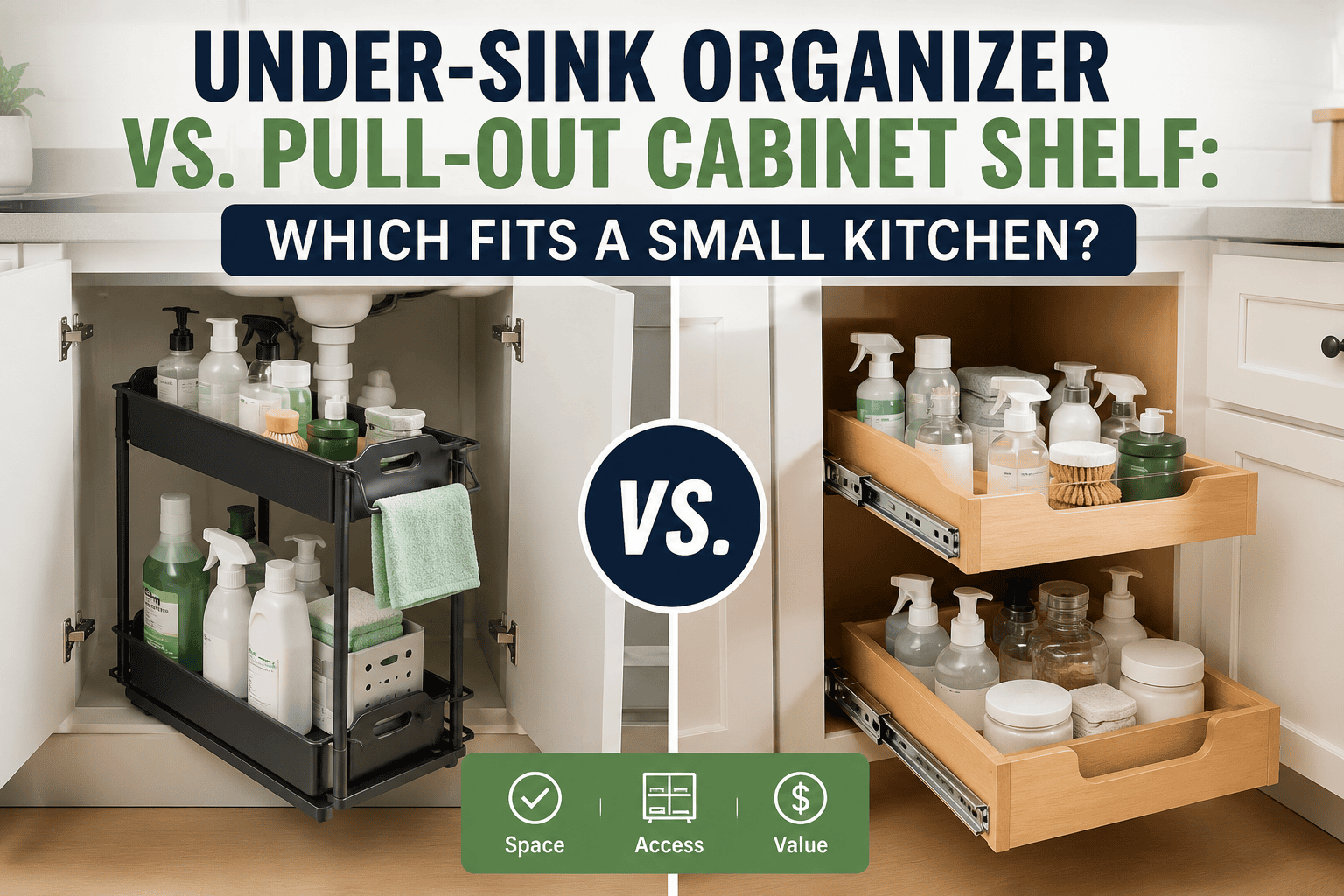
An under-sink organizer is a freestanding metal or plastic rack, usually with two or three sliding tiers, designed to sit around your plumbing rather than replace it. Most are adjustable in width and height, which matters because under-sink cabinets are rarely a standard size — the pipe placement, the P-trap, and the shutoff valves all eat into usable space differently from house to house.
Pros:
- No installation — it just sits on the cabinet floor
- Adjusts around pipes, since most models have a cutout or split design
- Cheap relative to storage gained, often $25–$45
- Easy to remove and clean underneath
- Works in rentals since nothing is mounted to the cabinet
Cons:
- Sits directly on the cabinet floor, so any leak pools underneath it first
- Sliding drawers can wobble on uneven or warped cabinet bottoms
- Doesn’t use vertical space above the top tier unless you stack organizers
What Is a Pull-Out Cabinet Shelf?
A pull-out cabinet shelf is a single sliding tray, usually wood, wire, or metal, mounted to the sides of the cabinet on drawer slides. Instead of tiers built around plumbing, it’s one flat surface — or a stacked pair — that glides out toward you like a drawer.
Pros:
- Full access to everything on the shelf in one pull, nothing buried behind other items
- Mounted to cabinet sides, so it doesn’t sit in the way of pipes at floor level
- Sturdier under heavier loads (large trash bins, bulk cleaning supplies)
- Looks more built-in and permanent, useful if you’re renovating rather than renting
Cons:
- Requires drilling and mounting hardware — a real install, not a drop-in fix
- Fixed width, so it needs to be measured and often custom-ordered for oddly shaped cabinets
- Usually $50–$120+ per shelf, more if buying a stacked kit
- Harder to remove for cleaning or if you move
Side-by-Side Comparison
| Under-Sink Organizer | Pull-Out Cabinet Shelf | |
|---|---|---|
| Install | None — just place it | Drilling/mounting required |
| Works around plumbing | Yes, most models | Only if cabinet is clear |
| Typical cost | $25–$45 | $50–$120+ |
| Best for | Cleaning supplies, small bottles, sponges | Trash bins, bulk items, single-category storage |
| Renter-friendly | Yes | Usually no |
| Weight capacity | Moderate (bottles, boxes) | Higher (heavier bins) |
| Adjustability | Width/height adjustable on most models | Fixed once mounted |
Which One Fits Your Cabinet?
The real deciding factor isn’t preference — it’s what your under-sink cabinet actually looks like.
Measure before you decide. Open the cabinet and check three things: how much clearance is there on either side of the pipes, is the cabinet floor level, and how far back does the cabinet go? A cabinet with pipes dead-center and shallow depth almost always works better with an organizer, since a pull-out shelf would either not clear the plumbing or need to be cut to a nonstandard size.
If you’re renting, skip the drill. A pull-out shelf usually means screws into the cabinet frame. If you’re not allowed to modify cabinetry — or just don’t want to deal with reversing it before a move — the organizer is the lower-effort option.
If you store one heavy item, not many small ones. A pull-out shelf holding a single trash can or recycling bin is more stable than trying to wedge a bin into a multi-tier organizer designed for bottles and boxes.
If your cabinet floor is warped or uneven (common in older homes), a floor-sitting organizer can rock or bind on its slides. A wall-mounted pull-out shelf avoids that problem entirely since it’s not resting on the floor.
Can You Use Both?
In deeper cabinets, yes — plenty of people combine them. A pull-out shelf handles a trash bin at floor level while a small organizer sits on top of a second, higher shelf for bottles and sponges. If your cabinet is deep enough (24 inches or more), stacking the two solves both the “single heavy item” and “many small items” problem at once.
Bottom Line
For most small kitchens, the under-sink organizer wins on cost, flexibility, and ease of install — it’s the better default choice, especially in rentals or cabinets with awkward plumbing. Reach for a pull-out shelf instead if you specifically need to store one bulky item like a trash can, your cabinet is unobstructed, and you’re fine with a permanent install.
for more news visit our blog