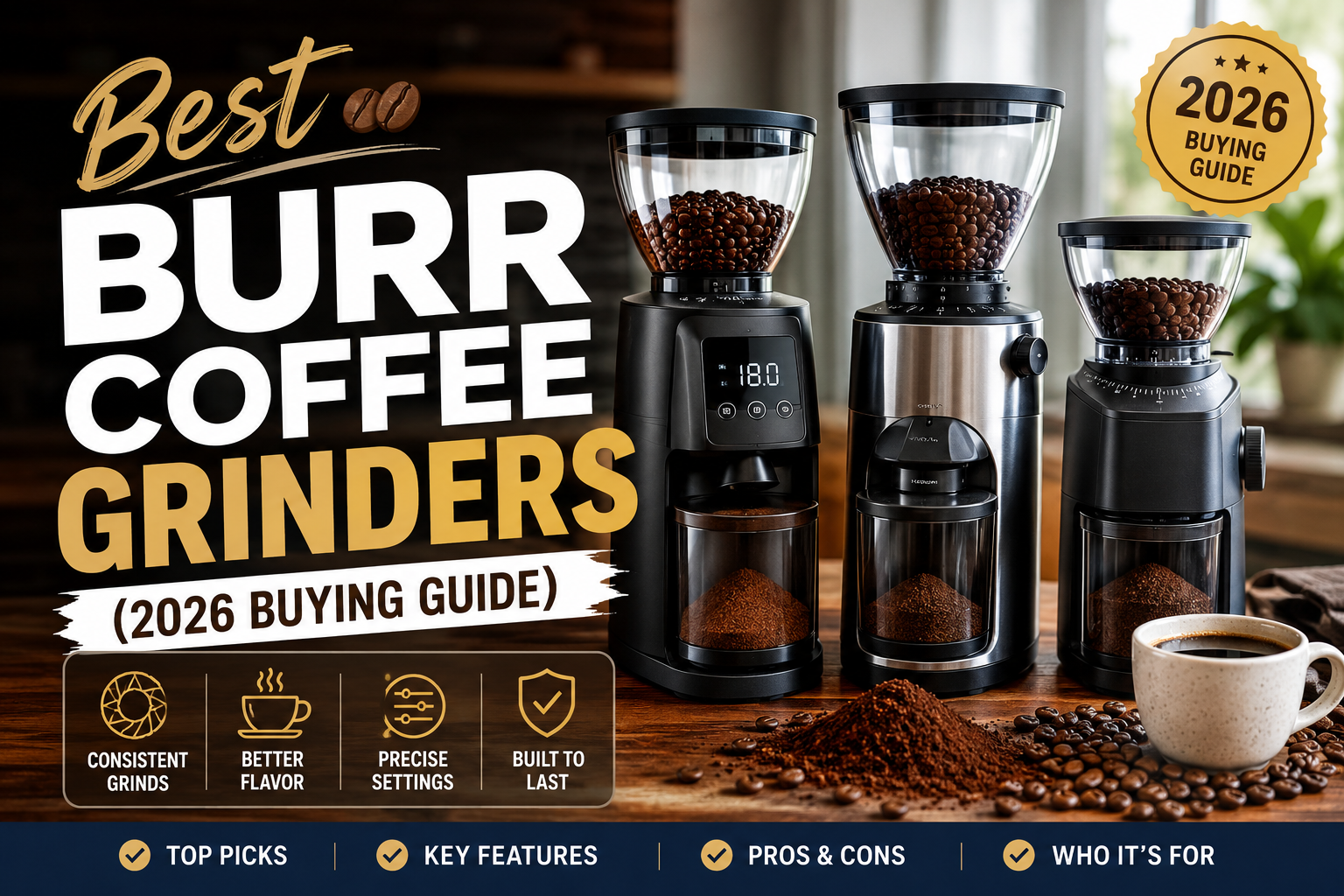
Best Burr Coffee Grinders (2026 Buying Guide)
This year, if you only upgrade one piece of coffee equipment, it should be your grinder. More than virtually anything else in your setup, including the brewer, water, and occasionally even the beans themselves, grind consistency has an impact on extraction. Coffee from pre-ground bags (or a $20 blade grinder) frequently tastes flat or bitter because a blade grinder cuts unevenly, producing a mixture of dust and chunks in the same batch. Burr grinders produce a far more homogeneous particle size by crushing beans between two abrasive surfaces that are spaced apart. The top choices for all budgets and brew styles are listed below.
Conical vs. Flat Burrs
Before picking a model, it’s worth knowing the two main designs:
- Conical burrs — a cone-shaped inner burr rotates inside a ring-shaped outer burr. Generally quieter, slower, and easier to clean.
- Flat burrs — two ring-shaped burrs spin parallel to each other. Often more consistent particle-to-particle, but usually louder and pricier.
In practice, the difference matters less than grind range and build quality at this price point — both designs perform well when properly calibrated.
Best Overall: Baratza Encore
For good reason, most reviews choose the Baratza Encore as their first choice for a grinder. It has simple controls, 40 grind settings that cover everything from espresso-like to French press, and steel conical burrs that last for years of daily use. Baratza also sells spare parts and burrs directly, which is helpful if you want to keep the machine for a long time. If you mostly drip or pour-over, the Encore can handle a wide range of grinds (see our guide to the best coffee makers under $200 for more information).
Budget alternative: the Encore ESP variant adds a few settings better suited to espresso, for a modest premium.
Best for Espresso: Breville Smart Grinder Pro
The Breville Smart Grinder Pro is a popular upgrade choice for people who want to make espresso. It has an LCD screen that shows grind time and settings at a glance, a portafilter base for direct dosing, and 60 grind settings. The dosage is based on time instead of weight, so you’ll need to use a small kitchen scale if you want to be exact to the gram. If you’re looking for a single-boiler espresso machine in the same price range, this one is a good choice.
Best for Filter Coffee: Wilfa Svart
There is a Wilfa Svart that was made just for you if you mostly make pour-over, drip, or batch filter coffee and not espresso. It’s made for the filter-brewing grind range instead of trying to cover all of them, which means that it’s more likely to be consistent within that range than grinders that try to do everything.
Best High-End Flat Burr: Fellow Ode Gen 2
The Fellow Ode Gen 2 is for flavor-focused home brewers who have outgrown entry-level grinders. It has flat steel burrs that are tuned specifically for filter coffee, which makes the particle distribution narrower and more uniform than most conical grinders in the same price range. It costs a lot more than $200, but you should know about it as a ceiling if you decide to spend in grinding.
Best Budget Pick
If you’re not ready to spend $150 or more on a grinder, a cheap cylindrical model (like those from Cuisinart and other similar brands, which cost well under $100) will still do a much better job than any blade grinder.
If you use it for years, the motor will break down and the grind settings will become less useful, but if you’re switching from pre-ground coffee, the cup quality will improve right away.
What to Look for When Buying
- Grind range — make sure it covers your brew method. Espresso needs a much finer, narrower range than French press or cold brew.
- Burr material — steel burrs are common and reliable; ceramic burrs run cooler and last longer but are pricier and can be more fragile if dropped.
- Stepped vs. stepless adjustment — stepped grinders (most home models) have fixed settings; stepless grinders allow infinite fine-tuning, which matters more for espresso than filter brewing.
- Dosing — time-based dosing is fine for most people; if you want repeatable espresso shots, pair any grinder with a cheap digital scale.
- Noise and retention — conical grinders tend to be quieter and retain less leftover coffee between grinds, which matters if you’re grinding small amounts daily.
Caring for Your Grinder
A grinder is a long-term investment, and a little maintenance keeps it performing like new:
- Run a grinder-cleaning tablet through every 2–4 weeks if you grind daily.
- Avoid grinding oily, dark-roast beans exclusively — oil residue builds up on burrs faster and can cause clogging.
- Empty the retention chamber periodically so old grounds don’t stale out fresh beans.
- Store beans properly before grinding — see our coffee bean storage guide for keeping beans fresh between grinds.
Frequently Asked Questions
Is a burr grinder really worth it over a blade grinder? Yes, for almost anyone who drinks coffee regularly. Uneven grind particles from a blade grinder extract at different rates during brewing, which is one of the most common causes of bitter or sour coffee at home.
Do I need a different grinder for espresso than for drip coffee? Not necessarily. Many mid-range grinders like the Baratza Encore or Breville Smart Grinder Pro cover both ranges reasonably well. Dedicated espresso grinders offer finer control but are usually a step up in price.
How much should I spend on a grinder vs. my coffee maker? If you’re working with a fixed budget, lean toward the grinder. A $150 grinder paired with a $50 drip machine will usually outperform the reverse — see our coffee makers under $200 guide for pairing recommendations.
Next step: pair your new grinder with a machine from our best coffee makers under $200 guide, and keep beans fresh with our coffee bean storage guide.


3 comments