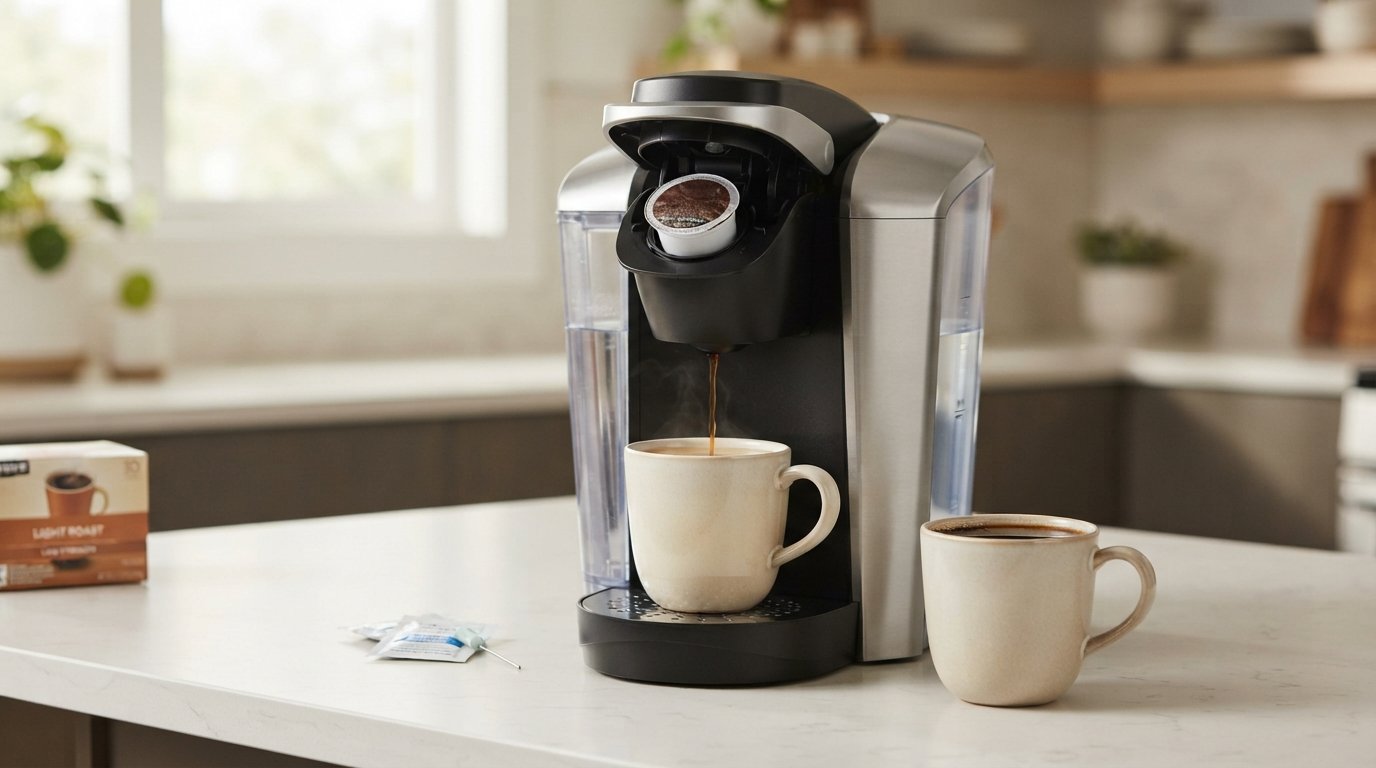
Most of the time, the problem is not with the coffee maker itself if your Keurig coffee tastes weak, watery, or less flavorful than usual. The taste of your coffee can be lowered by a big brew size, a weak or old K-Cup pod, mineral buildup, a needle that is stuck, or the wrong boiling setting.
It’s good to know that most of these issues are simple to fix.
There are a few main reasons why your Keurig coffee tastes weak. This guide will show you how to make it stronger and taste better.
Why Does My Keurig Coffee Taste Weak?
The most common causes include:
- 1. You’re Brewing Too Large a Cup
- 2. Turn On the Strong Brew Setting
- 3. Your K-Cup Pod May Be Weak or Old
- 4. Your Keurig Needs Cleaning
- 5. The Keurig Needle May Be Clogged
- 6. Mineral Buildup Is Affecting Water Flow
- 7. You’re Not Using Enough Coffee in a Reusable Filter
- 8. Your Water-to-Coffee Ratio Is Too High
- 9. The Brewing Temperature or Setting May Be Wrong
- 10. The Coffee Blend May Simply Be Too Mild
Let’s look at each cause in detail.
1. You’re Brewing Too Large a Cup
One of the easiest reasons for weak Keurig coffee is selecting a large cup size.
For example, if the same K-Cup is used to brew 6 oz, 10 oz, or 12 oz, the larger volume will generally produce a less concentrated cup.
Many Keurig models allow you to select different cup sizes. Some models, such as the K-Select, offer 6-, 8-, 10-, and 12-ounce options.
How to fix it
Try brewing a smaller cup.
If you normally select 10 or 12 oz, try 6 or 8 oz and compare the flavor.
If the smaller cup tastes noticeably stronger, your previous setting was probably diluting the coffee too much.
2. Turn On the Strong Brew Setting
If your Keurig has a Strong or Strong Brew button, use it.
Keurig says its Strong Brew function is designed to produce a stronger, more intense cup. On compatible models, the stronger setting changes how water passes through the pod to increase extraction.
How to use it
Depending on your model:
- Insert the K-Cup.
- Close the handle.
- Select Strong or Strong Brew.
- Select your preferred cup size.
- Start brewing.
If your coffee suddenly tastes stronger after enabling this setting, there may be nothing wrong with your brewer.
3. Your K-Cup Pod May Be Weak or Old
Sometimes the Keurig is working correctly and the K-Cup is the problem.
Different coffee blends naturally have different flavor and strength levels. A light roast, mild blend, or flavored coffee may taste considerably weaker than a dark roast.
A pod that has been stored improperly or for a long time may also produce less satisfying flavor.
Try this test
Use a different K-Cup that you know has a strong flavor.
Ideally, compare:
- Your usual K-Cup
- A dark-roast K-Cup
- A freshly purchased K-Cup
If only one type tastes weak, your brewer probably isn’t the main problem.
4. Your Keurig Needs Cleaning
Coffee residue can accumulate inside the brewer over time. Mineral deposits can also build up when water passes through the machine repeatedly.
Keurig explains that scale and calcium deposits can affect brewer performance and recommends descaling approximately every 3 to 6 months, depending on use and conditions.
What to do
Clean the removable components according to your model’s instructions.
Then run a proper descaling cycle using a descaling solution recommended for your brewer.
After descaling, rinse the system thoroughly according to the manufacturer’s instructions.
A dirty or scaled brewer can also cause other symptoms, such as slow brewing or reduced water flow.
5. The Keurig Needle May Be Clogged
Your Keurig uses needles to puncture the K-Cup during brewing.
Coffee grounds can sometimes accumulate around the needle area. If the water cannot pass through the pod normally, extraction may be affected.
How to fix it
Turn off and unplug the brewer and allow it to cool completely.
Clean the pod holder and needle area carefully according to the instructions for your specific Keurig model.
Do not put your fingers into the needle area. Keurig’s user guides warn that the needles are sharp.
If you’re unsure how to clean your particular model, check the official Keurig support page.
6. Mineral Buildup Is Affecting Water Flow
If you’ve had your Keurig for a long time and haven’t descaled it recently, mineral buildup could be contributing to the problem.
This is especially worth checking if you also notice:
- Slower brewing
- Less water coming out
- Unusual brewing behavior
- Changes in coffee flavor
- The brewer stopping during a cycle
Descaling removes mineral deposits that accumulate inside the brewer.
7. You’re Not Using Enough Coffee in a Reusable Filter
If you’re using a My K-Cup reusable coffee filter, the amount and grind of coffee can affect the final taste.
Too little ground coffee can produce a weak cup.
Try this
Make sure you’re using an appropriate amount of ground coffee for the reusable filter and your selected cup size.
Also avoid packing the grounds too tightly. Water needs to flow through the coffee properly for good extraction.
If you normally use reusable coffee and suddenly switched from K-Cups, compare the results with a standard K-Cup to determine whether the filter setup is responsible.
8. Your Water-to-Coffee Ratio Is Too High
Think of your Keurig as a simple ratio:
More water + the same amount of coffee = a less concentrated drink.
That’s why selecting a larger cup size can make the coffee taste weak.
For a stronger cup, try reducing the brew volume before making other changes.
Quick test
If your usual setting is:
12 oz → Try 8 oz
If 8 oz tastes much better, you probably don’t need to change the machine. You simply need a smaller brew size or a stronger pod.
9. The Brewing Temperature or Setting May Be Wrong
Some Keurig models provide temperature and strength controls.
For example, certain newer models offer multiple strength and temperature settings, allowing users to customize the brew.
If your model has temperature control, check that you’re not using an unusually low temperature setting.
However, don’t assume that maximum temperature automatically means better coffee. The correct settings depend on the brewer and coffee you’re using.
10. The Coffee Blend May Simply Be Too Mild
Not every coffee is intended to taste bold.
If your Keurig is clean, the water flow is normal, and the machine is brewing correctly, the coffee itself may simply be mild.
For a stronger flavor, try:
- Dark roast K-Cups
- Bold or extra-bold blends
- A smaller brew size
- Strong Brew mode
- A different coffee brand
Keurig itself offers models with Strong Brew specifically for users who prefer a bolder cup.
How to Make Keurig Coffee Stronger
If you want a quick solution, try these steps in order:
| Step | What to do |
|---|---|
| 1 | Select a smaller cup size |
| 2 | Turn on Strong Brew if available |
| 3 | Try a dark-roast or stronger K-Cup |
| 4 | Clean the pod holder and needle area |
| 5 | Clean the water reservoir |
| 6 | Descale the Keurig |
| 7 | Check your reusable filter if you use one |
| 8 | Test another K-Cup |
In many cases, smaller brew size + Strong Brew + a fresh, bold K-Cup is enough to noticeably improve the flavor.
Why Does My Keurig Coffee Taste Watery?
Most of the time, watery coffee means that the coffee is being diluted too much or isn’t being extracted properly.
Reduce the size of the cup as the first test.
If you’re making 12 oz, try 6 or 8 oz instead. You can be sure that the machine is working properly if the coffee gets much stronger. The original brew volume may have been too high for your taste.
If the coffee stays watery even when the setting is lowered, clean the maker, look at the needle area, and descale the machine
Why Does My Keurig Coffee Suddenly Taste Weak?
If your coffee used to taste normal but recently became weak, focus on maintenance first.
Check:
- K-Cup — Try a new pod from a different package.
- Water flow — Make sure the brewer is dispensing normally.
- Needle — Check for coffee-ground buildup.
- Descaling — Consider whether the brewer is overdue for descaling.
- Settings — Make sure the cup size or strength setting hasn’t changed.
A sudden change is more likely to point toward the pod, settings, cleanliness, or water flow than simply your taste preference.
Should You Run a Keurig Twice for Stronger Coffee?
It’s generally better to use the brewer’s Strong Brew setting or choose a smaller brew size rather than repeatedly running water through the same used K-Cup.
A used pod has already had coffee extracted from it, so running additional water through it may produce a weak or watery drink.
If you want a larger but stronger drink, consider brewing another fresh K-Cup rather than repeatedly using the same pod.
When Should You Descale a Keurig?
Keurig states that descaling should generally be performed every 3 to 6 months to help maintain brewer performance, although the exact interval can vary with use and water conditions.
You may want to descale sooner if you notice:
- Weak or unusual coffee flavor
- Slow brewing
- Reduced water flow
- Mineral deposits
- The brewer behaving differently than usual
Always follow the instructions for your specific Keurig model.
Frequently Asked Questions
The most likely explanations are a large brew size, a mild K-Cup, or the absence of a Strong Brew setting. Try an 6–8 oz brew with a fresh, bold K-Cup.
Yes. On compatible Keurig models, the Strong Brew function is specifically designed to produce a stronger, more intense cup.
Yes. Coffee residue and mineral buildup can affect brewer performance and water flow. Regular cleaning and descaling can help maintain normal operation.
Keurig recommends descaling approximately every 3–6 months. Your actual schedule may vary depending on how frequently you use the brewer and the water you use.
Not necessarily. “Strong” can refer to perceived flavor intensity, roast characteristics, or caffeine content. A dark roast often tastes bolder, but roast level alone doesn’t tell you everything about a coffee’s strength.
Final Thoughts
When Keurig coffee tastes weak, don’t assume the coffee maker is broken. Start with the easiest fixes: select a smaller cup size, use Strong Brew if your model has it, and try a fresh or darker K-Cup.
If the problem continues, clean the brewer, check the needle area, and descale the machine. These basic maintenance steps can restore normal water flow and brewing performance.
If your Keurig still produces weak coffee after cleaning and descaling, testing another K-Cup brand or coffee blend can help determine whether the issue is with the brewer or simply the coffee you’re using.
Related:







