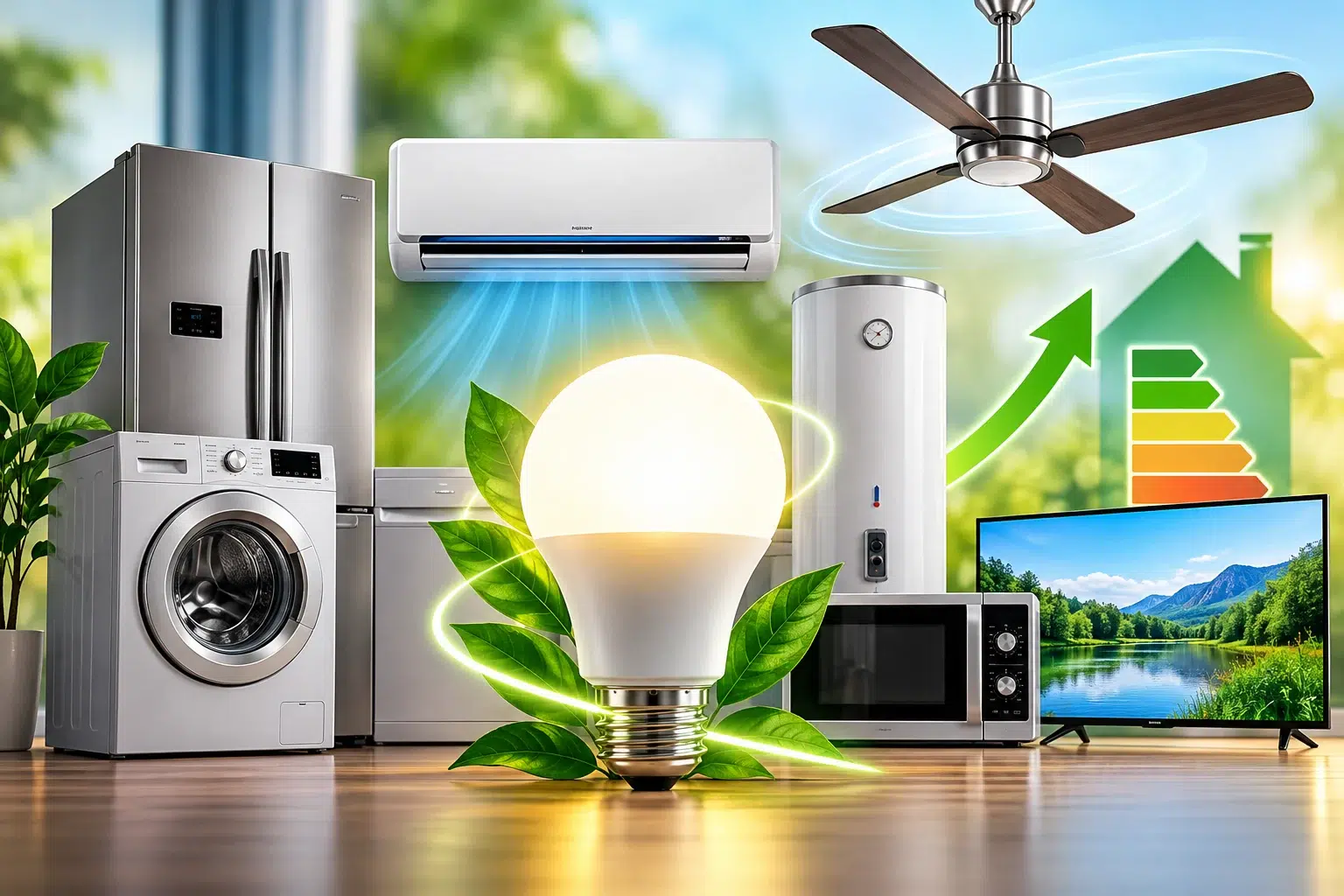

Discover the best appliances that save electricity, reduce energy consumption, lower monthly bills, and protect the environment.
One of the most important things we need in today’s world is electricity. Electricity is important for almost every part of daily life, from lighting our homes and running our appliances to running factories, schools, hospitals, and businesses. As technology keeps getting better, more and more people depend on electrical appliances to make their lives easier, more comfortable, and more productive. But because of rising energy costs, more people needing electricity, and worries about the environment, it is important to use electricity wisely. Choosing appliances that use less electricity is one of the best ways to cut down on your power bill.
Energy-efficient appliances perform the same tasks as regular appliances while consuming less electricity.
They use smart controls, better technology, and energy-efficient parts to cut down on waste without affecting performance. These appliances can help people lower their monthly energy bills, protect natural resources, and lower the pollution that comes from making electricity. Sometimes the price of energy-efficient appliances is higher, but the money you save in the long run makes it worth it.
Understanding Energy-Efficient Appliances
Electrical appliances that save electricity to do their job are called “energy-efficient.” How well they turn electricity into useful work determines how efficient they are. For instance, a refrigerator that is efficient keeps the right temperature while using less power, and a washing machine that is efficient cleans clothes while using less water and energy.
Several things affect how much electricity an appliance uses: its power rating, how long it is used, its design, how old it is, and how well it is taken care of. It is usually true that an appliance with a higher wattage will use more electricity for the same amount of time than an appliance with a lower wattage. However, wattage alone doesn’t show how efficient something is because different machines can do different amounts of work. So, before buying an appliance, people should look at other appliances of the same size and ability and see how much energy they use.
Buyers can find goods that use less electricity with the help of energy labels and ratings. Labels may show annual energy use, efficiency grades, or other standard performance information based on the country and type of product. By comparing these details, buyers can find appliances that strike a good balance between cost, performance, durability, and running costs.
LED Lights: A Simple Way to Save Electricity
Lighting is an important part of every home, business, public space, and office. Most of the energy that traditional incandescent bulbs use is turned into heat instead of light, so they use a lot of electricity. LED bulbs, which stand for light-emitting diode bulbs, are a better choice. Switching to LED bulbs is an easy way to Save Electricity and lower your monthly bills. Use our LED savings calculator to estimate how much money you can save by replacing traditional bulbs with energy-efficient LED lighting.
LED lights use semiconductor technology to make light, and they usually use a lot less electricity than regular incandescent bulbs that give off the same amount of light. They also last a long time, which means they don’t need to be replaced as often and make less waste when they’re thrown away.
For instance, switching from a regular 60-watt incandescent bulb to an LED bulb that gives off the same amount of light but only uses 9 watts can save a lot of electricity. The incandescent bulb uses about 9.1 kilowatt-hours of electricity per month if it is on for five hours every day, while the LED bulb uses about 1.35 kilowatt-hours. This means that about 85.5 percent less electricity is being used for that light.
When many bulbs are changed in a home or business, the saves can add up quickly. People should pick LEDs that have the right quality, brightness, and color temperature. You can reduce electricity consumption further by switching off unnecessary lights and using natural daylight whenever possible.
Energy-Efficient Refrigerators
Because they work all day and night, refrigerators are one of the most important home equipment. They help keep food fresh and drinks cold, and they keep food from going bad. Because refrigerators run continuously, even a small improvement in energy efficiency can save households a significant amount of money over time.
Modern refrigerators that use less energy have better insulation, more efficient compressors, better temperature controls, and cooling systems that were carefully thought out. Instead of always running at the same speed, inverter refrigerators can change the speed of the compressor based on how much cooling is needed. In the right operating conditions, this can lower the amount of electricity used, but the actual savings will depend on the model, the room temperature, how it is used, and how well it is maintained.
When people buy a refrigerator, they should think about how much power it uses yearly, how much space it takes up, its energy rating, and whether it will work for their home. If you don’t need all that extra storage space, a very large fridge may waste energy. So picking the right size is just as important as picking a model that works well.
How a fridge is used can also change how much energy it uses. It will work better if you keep it out of direct sunlight and away from machines that make heat. It is also possible to use less energy by keeping the door closed, letting hot food cool before putting it inside, keeping the temperature at the right level, and cleaning the condenser coils as directed by the manufacturer. If the door seals are broken, you should fix them because warm air entering the fridge makes the cooling system work harder.
Inverter Air Conditioners
In places where it gets hot, especially in the summer, air units are very common. However, cooling rooms can use a lot of electricity, especially when regular air conditioners are used for long periods of time. Inverter air conditioners are a better way to keep your home at a comfortable temperature.
To keep the temperature where it was set, a normal air conditioner often turns its compressor on and off. An inverter air conditioner can change the speed of the compressor based on how much cooling is needed. Once the temperature is right, it doesn’t have to keep running at full power. Instead, it can lower its working capacity. This method can make things run more smoothly, especially when they have to be done for long amounts of time.
The actual savings depend on the energy rating of the appliance, the temperature outside, the size of the room, its insulation, how many people are in it, and how the thermostat is set. People should compare the estimated seasonal efficiency and energy use of different models of air conditioners because an inverter air conditioner isn’t always the most energy-efficient choice.
It is very important to choose an air conditioner that is the right size. A unit that is too small might not be able to cool a room well, and a unit that is too big might not work well in some situations. For better cooling, make sure the unit is installed correctly, clean the air filters, seal any gaps around doors and windows, and block direct sunlight with curtains or blinds.
You can also save electricity by setting the thermostat to a reasonable level instead of one that is too low. More ways to save energy are to use fans to move air around, close doors to rooms that aren’t being used, and turn off cooling systems when they’re not needed.
Energy-Saving Washing Machines
Washing machines make doing laundry easier and lessen the amount of work that needs to be done by hand. But how much electricity they use depends on how they are washed, the temperature of the water, the size of the load, how long the cycle lasts, and the design of the machine.
Newer washing machines that use less energy have better motors, sensors, and washing programs that use less water and electricity. Most of the time, front-loading washers use less water than top-loading washers, but this depends on the product and how it is washed. Some machines have technology that changes the water level and cycle settings based on how much laundry there is.
Many of the energy used by a washing machine during a cycle can go toward heating water when it has a hot-water program. This demand can be lowered by washing clothes in cold water whenever it makes sense, especially when the machine would otherwise heat the water electrically.
Consumers can save energy by choosing the right eco mode, washing loads that are full but not overloaded, and using shorter or lower-temperature cycles when they clean well enough. If you put too much in your washing machine, it might not clean as well, and if you run it with very little, it might waste water and energy if it doesn’t change its usage to match.
A washing machine will work well as long as the filters are cleaned regularly, the hoses are checked, and the manufacturer’s maintenance instructions are followed. Instead of depending only on how something looks or what features it says it has, people who are buying a new model should compare standardized energy and water consumption figures.
Energy-Efficient Fans
Fans are common home appliances, especially in warm places where they’re an inexpensive way to make people feel better. Ceiling fans, pedestal fans, and table fans all move air around and make a place feel cooler without necessarily making it cooler.
Older ceiling fans with motors that aren’t as efficient may use more electricity than newer types that are made to use less power. Brushless direct-current (BLDC) fans use electronic motor controls and can save a lot of energy compared to many other types of fans, though this depends on the models being compared and how fast they run.
Fans are used for a lot of hours every day, so choosing an energy-efficient model can save you a lot of money in the long run. People should look at how much power different fans use at the same level of airflow and pick one that fits the room.
Installing things correctly and cleaning them often can also make them work better. If dust builds up on the blades, it can block the flow of air, and broken or loose parts can make the machine less effective or even dangerous. Fans should be turned off when no one is in the room. When air conditioning is used, a fan might make people more comfortable at a slightly higher temperature setting, which could lower the cost of cooling.
Solar Water Heaters
In homes, hotels, hostels, and other buildings, heating water can use a lot of power. Solar water heaters get their power from the sun, while regular electric water heaters use electrical resistance elements to heat water.
Solar water heating systems usually have solar collectors, a storage tank, pipes, and parts that control the temperature. The collectors take in the sun’s heat and either send it directly to the water or through a heat-transfer fluid. The system stores hot water in a tank until people need it.
Solar water heaters can lower the amount of electricity needed to heat water, especially in places with lots of sunshine. In Pakistan, where many places get strong sunlight for most of the year, they can be especially helpful. But how well they work depends on the weather, the size of the system, how well it was installed, how much demand there is in the home, and how well it is maintained.
When there isn’t enough sunlight, some systems use an electric heater as a backup. Insulating the storage tank and hot water lines correctly helps keep the heat in and cuts down on the need for extra heating.
Even though solar water heaters can be expensive to buy at first, the lower power bills may make up for some of that cost over the system’s lifetime. Before buying a system, buyers should think about the climate where they live, the amount of roof space they have, the cost of installation, the quality of the water, the warranty, and how often they plan to maintain the system.
Solar panels and making electricity at home
Another important technology for becoming less reliant on electricity from the grid is solar panels. Solar panels get their power from the sun, while energy-efficient appliances lower the amount of electricity needed to do everyday tasks.
Sunlight is turned into electricity by a solar photovoltaic device. It can go straight to home appliances and power them, work with the power grid, or be mixed with batteries to store energy for later use. What kind of system is needed depends on how much electricity the home needs, how much money the family has, how much roof space they have, and how electricity works in their area.
Homeowners who use a lot of electricity during the day may find solar panels to be especially useful. During times of strong solar generation, appliances like washing machines, water pumps, and others can sometimes be used to get the most out of the electricity that is made.
But solar panels don’t get rid of energy bills by themselves. Grid-connected systems may still have fixed costs, and using electricity at nite may need power from the grid or batteries. Savings depend on the size of the system, how well it was installed, how much sunlight there is where you live, the cost of electricity, and any rules that apply.
Before putting in a solar system, homeowners should look at their electricity bills and how much electricity they use each day. They should also compare reputable installers and learn about the rules for connecting to the grid and getting paid. Inspections and cleanings done on a regular basis help keep performance high.
Energy-Efficient Electric Water Heaters
If solar water heating isn’t possible, an electric water heater that works well can help cut down on electricity use. Traditional storage heaters keep a certain amount of hot water in a tank, but the walls of the tank and the pipes that connect to them can sometimes lose heat. These losses can be cut down with better insulation.
Another choice is a heat pump water heater. They don’t make all the heat through electrical resistance; instead, they move heat from the air around them into the water. As long as the conditions are right, this process can give off more heat energy than it uses. But heat pump water heaters might cost more at first and need the right amount of room, air flow, and installation.
People should compare the energy efficiency, capacity, recovery time, and needs for operation of various water heaters. Picking a tank size that fits your home’s needs will help you avoid heating water that isn’t needed. You can also make things work better by insulating the right hot water lines, setting the temperature to meet safety and usage needs, and fixing any leaks.
The best choice depends on the weather, the cost of electricity and installation, the amount of space that is available, and how much hot water the household needs.
Energy-Efficient Televisions and Entertainment Devices
In today’s homes, you can find TVs, game consoles, sound systems, and streaming devices. Many of these devices use less electricity than big appliances like air conditioners, but when they all work together for a long time, they can still add up to a lot of electricity.
Newer display technologies, like LED and other energy-efficient ones, usually use less power than older ones of the same size and brightness. But the amount of power used depends on the model, screen size, brightness setting, resolution, and refresh rate.
Before buying a TV, people should look at the energy labels and compare the rated power consumption. Choosing the right screen size and turning down the brightness when it’s not needed can help save electricity without making the watching experience much worse.
Pay attention to standby consumption too. Some TVs, game consoles, and entertainment systems keep using power even when they look like they are turned off. Turning on energy-saving settings, using automatic sleep modes, and turning off devices that aren’t being used can help cut down on waste. Smart power strips may help you control more than one device at once, as long as turning them off doesn’t mess up important functions or updates.
Energy-Saving Computers and Office Equipment
Computers and other office supplies are necessary for business, schooling, and working from home. Devices like desktop computers, laptops, printers, monitors, and networking gear all use electricity.
Most of the time, laptops use less electricity than many desktop computers because they are made to be movable and work well on batteries. Still, consumption varies a lot depending on the workload, screen size, graphics hardware, and processor performance. Desktop computers and monitors that use less power can also help homes and businesses save energy.
Power-management tools on modern computers often lower the amount of power used when devices are not in use. It is possible to save electricity by setting monitors to turn off after a certain amount of time and letting computers go into sleep mode. Depending on the device and how long it needs to be in sleep, turning off completely equipment that won’t be used for a long time may also lower consumption.
Printers should only be turned on when they’re needed, and users can avoid printing things they don’t need to by storing and sharing files digitally. To be even more efficient, offices should choose equipment that uses little energy, combine printing tasks, and get rid of old devices only when the long-term savings are worth it.
Energy-Efficient Kitchen Appliances
Appliances in the kitchen, like electric kettles, microwave ovens, induction cooktops, ovens, and dishwashers, can use electricity. How well they work depends on the technology, the way the food is cooked, the amount of food, and how often they are used.
Most of the time, electric kettles are a good way to heat water because the heating element goes straight into the water. But it’s a waste of energy to boil more water than you need to. So, filling the kettle only with the amount needed can cut down on consumption.
Because they heat food without needing a big oven space, microwave ovens can be useful for reheating food and making smaller portions. Sometimes, regular ovens are better for certain recipes or cooking bigger amounts. The best choice depends on the job, the time it takes to prepare, and how well the appliance works.
Induction cooktops use an electromagnetic field to heat cookware that is compatible with them. The field can efficiently transfer energy to the cooking vessel. When cooking, induction technology can save more energy than many traditional electric resistance cooktops. Its benefits depend on the type of cookware you use, how you cook, and where you get your energy.
Dishwashers with good wash programs can use less water and energy than some ways of washing dishes by hand, especially when they are used with full loads and the right eco settings. But the results depend on how the water is heated where you live, how well your dishwasher works, and how you wash dishes by hand.
Simple habits can help you get more done in the kitchen. Using cookware that is the right size, keeping lids on pots when it’s appropriate, cooking with the right method for the amount of food, and turning off machines when they’re not needed can all help cut down on electricity use.
Energy-Efficient Water Pumps
People use electric water pumps in their homes, on farms, in businesses, and in factories. In many homes, pumps keep the water flow in the plumbing system or move water to tanks above the house. How much power they use depends on how well the motor works, how big the pump is, how much water they need to move, how long they run, and how high or how much pressure the water needs to be moved against.
If the pump is too big or not the right size, it may use more electricity than it needs to. Should the pump be too small for the job, it might run for too long or not provide enough flow. So, it’s important to choose a pump that is the right size and works well.
Modern pumps may have motors that work efficiently and settings that let you change the speed of the pump to match the demand. In situations where water needs change, these kinds of systems can help save energy. But the benefits depend on how the plumbing works and how the pump is set up.
You can also save electricity by keeping pipes in good shape, checking for leaks, cleaning filters when needed, and not running machines when they’re not needed. If the system is set up and kept up to date correctly, automatic level controls may help keep pumps from running when a storage tank is full.
Smart Home Technology and Automatic Controls
Smart home devices can help people keep an eye on and control how much power they use. With smart thermostats, programmable timers, occupancy sensors, and energy-monitoring plugs, people can better control their machines.
When someone walks into a room, occupancy sensors can turn on the lights. When no one is in the room, the sensors can turn off the lights. Programmable timers can set up a schedule to run the right devices at the right time, and smart thermostats can change the temperature or air conditioning based on who is in the room and what they need.
Devices that track energy use can show how much electricity a machine uses over time. This information helps people find appliances that use more electricity than they thought they would and decide if changing the way they use them would be a good idea.
But smart devices use electricity too, and not all smart appliances are energy-efficient. If the energy saved by better control is more than the electricity used by the controls and the cost of the equipment, then they are valuable. People should pick goods that they can trust, keep their connected devices safe, and set their automation to reduce waste in a real way.
The Importance of Energy Labels and Efficiency Ratings
Energy labels tell you useful things about how much electricity an appliance uses and how well it works. A label might show an efficiency grade, an estimate of how much the unit will cost to run each year, or some other standard measurement, depending on the object and the country’s labeling system.
People who want to compare appliances should look at the numbers for items that have similar functions and capacities. Even if it is pretty energy-efficient for its size, a bigger refrigerator may use more electricity overall. In the same way, an air conditioner should not only be judged by how much it costs, but also by how well it cools and how well it works during different seasons.
Buyers should also consider durability, warranty coverage, repairability, availability of spare parts, and maintenance requirements. A cheap appliance that uses a lot of electricity or breaks down a lot may end up costing more in the long run than a better-designed one.
Keep in mind that energy labels and rating systems are not the same in every country or type of product. People shouldn’t assume that a rating scale means the same thing everyplace; instead, they should use the information that is written on the label in their own language.
Calculating Electricity Consumption and Potential Savings
Knowing how much electricity a home uses helps people make smart choices. Kilowatt-hours, or kWh, are a common way to measure how much electricity someone uses. One kilowatt-hour is equal to the amount of energy that a 1,000-watt gadget uses in one hour.
You can guess how much electricity an appliance uses by multiplying its kilowatt-hour power by the number of hours it runs. One example is a 100-watt fan that runs for eight hours and uses about 0.8 kWh of electricity. Based on the same conditions, it will use about 24 kWh if it runs for 30 days.
Let’s say a family changes a 100-watt fan with a 40-watt fan that works just as well and uses less power. The older fan would use about 24 kWh over 30 days, while the more energy-efficient fan would use about 9.6 kWh. Both fans would run for eight hours every day. It would cost 14.4 kWh more each month.
The household can figure out how much money it will save by multiplying the amount of electricity it saves by its current marginal rate per kWh. Electricity rates can change because they include taxes, fixed charges, slab rates, time-of-use rates, and other things. This means that the actual bill reduction may be different.
You can also use this method to contrast lights, fridges, air conditioners, and other home appliances. When comparing things like freezers and air conditioners, using the annual usage numbers from the maker or the energy label might be more accurate than just using the rated wattage.
Understanding how much electricity your household appliances consume is an important step toward reducing energy bills. Read our guide on appliance energy costs to learn more about electricity consumption and how to save money.
The Environmental Benefits of Energy-Efficient Appliances
Not only does saving energy help the environment, but it also cuts down on your electricity bills. In order to make electricity, fossil fuels may need to be burned, which releases carbon dioxide and other pollution. So, cutting down on electricity use that isn’t needed can lower emissions if the electricity that was saved would have come from polluting sources otherwise.
Using appliances that use less energy can also ease the load on systems that make and distribute electricity. When people and businesses use less electricity when demand is high, utilities may not have to add more power plants or rely on power sources that aren’t as efficient.
LED lighting uses less energy and usually lasts longer than regular lighting. Also, freezers and air conditioners that use less electricity can lower ongoing electricity demand. Solar panels and water heaters can help the environment by using renewable energy, but their full effect on the environment will depend on how they are made, installed, maintained, and thrown away.
People should also think about how to properly get rid of old items. Air conditioners and refrigerators may contain refrigerants that need to be handled properly. Electronic equipment may also contain materials that shouldn’t go into regular trash streams. Recycling at the right places helps protect the environment and get back useful things.
Challenges in Adopting Energy-Efficient Appliances
Even though they are good for you, there are some reasons why people might not buy energy-efficient appliances. One of the main problems is the price of the original purchase. Some freezers, air conditioners, washing machines, and solar systems that use less energy cost more than simpler ones, even if they save you money in the long run.
It can also be hard for customers to compare products when they don’t know much about them. Advertising might focus on features or looks instead of how much electricity is used. Unreliable information about the product, bad repair services, and not being able to get replacement parts can also affect buying choices.
Another problem is that people may expect to save money right away without thinking about how they use things. Even if you run an energy-efficient air conditioner at a low temperature for a long time, it may still use a lot of electricity. In the same way, putting a very energy-efficient fridge that is much bigger than needed may lead to more overall consumption.
These problems can be fixed by educating consumers, making sure energy labels are clear, making loans easier to get, making sure products meet reliable standards, and making it easier to get qualified repair services. Making efficient technologies easier to understand and cheaper is something that governments, manufacturers, retailers, and energy providers can all do to help.
Choosing Appliances That Provide the Best Value
It’s not always the case that the most expensive or high-tech appliance is also the most energy-efficient. That one meets the user’s needs and strikes a good balance between how much energy it uses, how reliable it is, how well it works, and how much it costs over its lifetime.
People should think about how often they will use an appliance, how long they think it will last, and how much electricity it will likely use before they buy it. Investing in an energy-efficient refrigerator makes sense because it runs continuously. Similarly, households that use air conditioning for long hours every day can save money by choosing an efficient air conditioner.
Taking into account the total cost of ownership is a good way to compare different choices. This includes the purchase price, operating costs, repair expenses, and expected lifespan.
We shouldn’t just assume that every appliance will pay for itself quickly; instead, we should look at how much money it saves over a reasonable amount of time.
Also, people shouldn’t throw away a working appliance just because a newer model is available. In some situations, it may make sense to keep using a well-kept appliance. On the other hand, it may be time to get rid of an old, useless appliance that is used for long hours. The choice should be based on accurate numbers about how much is used, how much it costs to fix, and the expected benefits of the new equipment.
Practical Ways to Maximize Electricity Savings
Buying appliances that use less energy is a good start, but sensible use is just as important. People shouldn’t leave their lights, fans, TVs, and other electronics on when they’re not using them. Also, when possible, they should use energy-saving modes and follow the manufacturer’s instructions for how to use and take care of the equipment.
To keep your air conditioner in good shape, you should clean the filters on a regular basis and make sure all the doors and windows are closed properly when the cooling is on. The door seals on refrigerators should work, and washing machines should be used with the right loads and cycles.
People can keep an eye on their electricity bills to see if there are any strange increases in usage. If their bill goes up without warning, they can look at how much they use their appliances, see if any of them are broken, and think about whether the rise is due to seasonal changes or changes in their daily tasks. Plug-in energy monitors can be helpful for checking how much power some appliances use, but only if they are used safely and with the right appliance.
Spreading out your energy use throughout the day can also help it work better when it’s possible to do so. People who have solar panels may get more use out of some appliances when the sun is shining. People who pay time-of-use tariffs might be able to save money by using the right equipment during cheaper times, but only if the tariff actually lets them do that.
The Role of Governments, Businesses, and Consumers
To promote appliances that use less energy, governments, manufacturers, retailers, businesses, and consumers all need to work together. Governments can support energy economy by setting standards for appliances, starting labeling programs, educating the public, and making rules that encourage smart energy use.
Manufacturers can make products that work better and use less electricity, and retailers can help customers compare how much energy a product uses and how much it will cost to run in the long term. Schools and other places of learning can teach students how to save energy and how wasteful consumption can hurt the environment.
Businesses can also lower their electricity costs by upgrading old cooling systems, installing energy-efficient lighting, using automatic controls, and keeping an eye on how much energy they use. Large buildings can save the most energy by upgrading equipment and changing how they operate, as energy audits help identify the best opportunities.
Consumers play an important part too. People can lower their electricity bills and help save energy at the same time by choosing energy-efficient products, keeping their appliances in good shape, and not doing things that are pointless. For more information about energy-efficient appliances and ways to reduce electricity consumption, visit the U.S. Department of Energy, which provides practical guidance on saving energy at home.
Conclusion
In today’s world of green living, appliances that use less power are very important. When chosen and used correctly, LED lights, energy-efficient refrigerators, inverter air conditioners, energy-saving washing machines, modern fans, solar water heaters, solar panels, and energy-efficient kitchen and office equipment can all help lower electricity use.
There are more benefits than just saving money. Energy-efficient appliances can help protect natural resources, lower the demand on the power grid, and lower the pollution that comes from making electricity. Some products may have a higher upfront price, but their lower operating costs can save money over time.
Energy waste is a problem that needs more than just technology to fix. People who buy appliances need to know how they work, be able to compare accurate energy ratings, pick the right models, and keep their gear in good shape. Simple habits, such as switching off unused devices, setting appropriate temperatures, and avoiding unnecessary appliance use, can make a big difference.
In the end, everyone needs to do their part to save power. Every home, business, school, and other group can help by making smart decisions and using energy effectively. appliances can save electricity, protect the environment, and move toward a more reliable and long-lasting energy future by using modern technology and good habits.