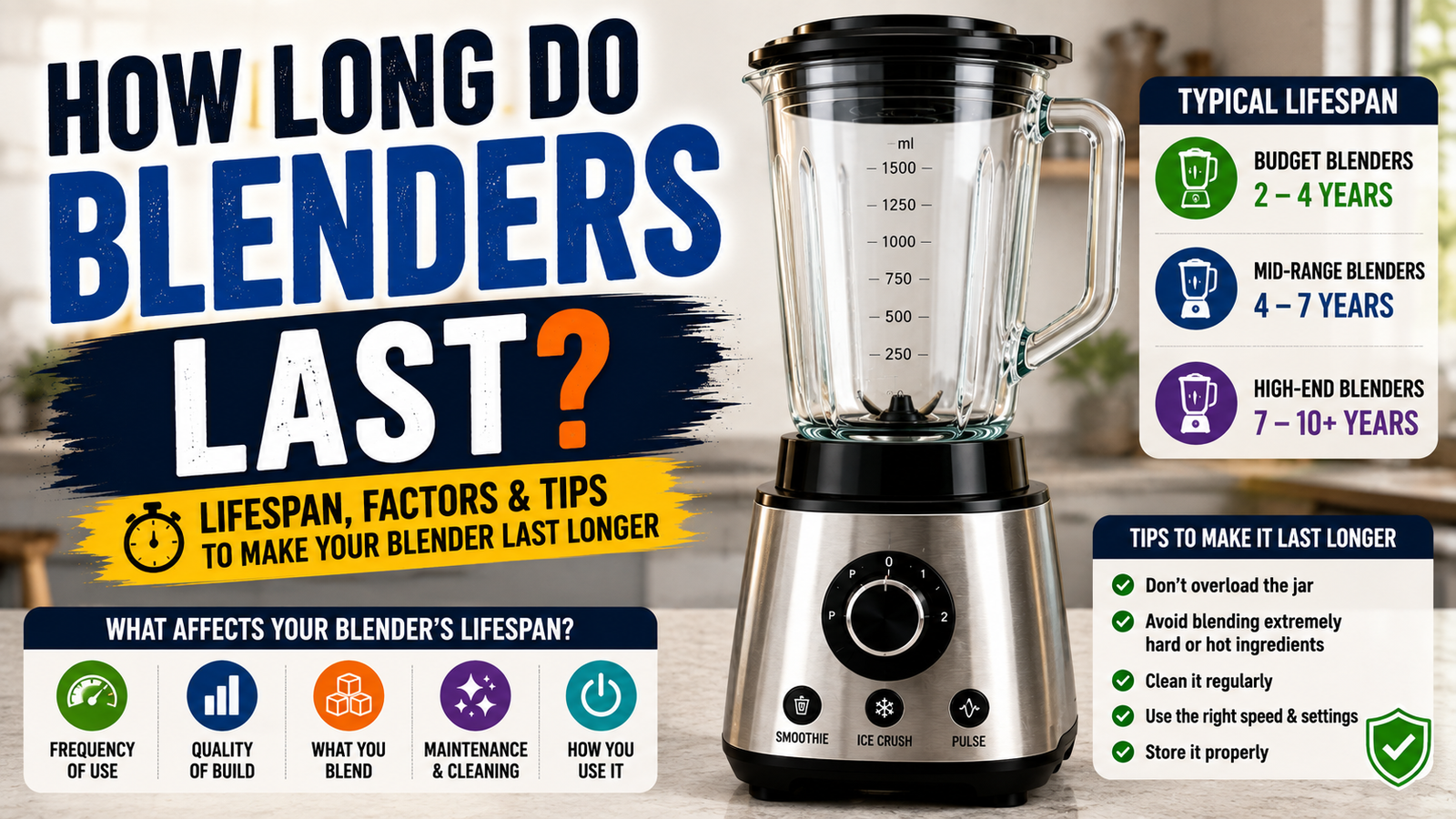

One of the most useful things in your home might be the blender. A good blender can be used every day or several times a week to make smoothies, soups, sauces, and frozen drinks, But how long do blenders last?
Most home blenders last between 3 and 7 years, but the exact amount of time they last depends on how well you take care of them, how often you use them, and what you blend.
Some basic blenders may need to be replaced more often, but models that are well-built and well-kept can last for many years.
In this guide, we’ll explain how long different types of blenders typically last, what affects their lifespan, signs that your blender is wearing out, and how to make your blender last longer.
How Long Does the Average Blender Last?
If you use your blender every day, the average one will last between 3 and 7 years.
But keep in mind that this is just a guess. If you only use your blender once in a while to blend soft fruits, it might not get worn out as quickly as one you use every day to crush ice and frozen foods.
Several factors influence how long a blender lasts, including:
- Motor quality
- Frequency of use
- Type of ingredients
- Blade quality
- Cleaning and maintenance
- How the blender is stored
- Whether it is overloaded
- Overall build quality
A higher-quality blender may cost more initially but can potentially provide a longer service life when used and maintained correctly.
How Long Do Cheap Blenders Last?
Some cheap blenders can last for years, especially if they’re not used very much.
Cheaper models, on the other hand, might have motors that aren’t as strong, parts that aren’t as durable, or plastic parts that wear out faster.
A cheap blender might last longer than you think if you only use it for soft fruits, veggies, and liquids.
Crushing ice, nuts, frozen foods, or other tough ingredients too often can put extra stress on the motor and blades.
How Long Do High-End Blenders Last?
Most high-end blenders are made to be used more often and with more weight.
A good blender might last 5 to 10 years or longer with proper care, but this depends on the type, how often it is used, and how well it is taken care of.
Some companies also offer longer warranties or replacement parts for certain types, which can make it easier to own for a long time.
However, a longer lifespan isn’t always guarantyd by a higher price. It’s still important how you use the blender.
What Determines a Blender’s Lifespan?
1. Motor quality
The motor is one of the most important components of a blender.
Repeated overheating, overloading, or running the blender longer than recommended can put unnecessary stress on the motor.
2. Frequency of use
A blender used once a week generally experiences less wear than one used several times every day.
Frequent users should choose a blender designed for their workload.
3. What you blend
Soft ingredients are relatively easy for a blender to process.
Hard or demanding ingredients can place more stress on the motor and blade assembly.
Examples include:
- Ice
- Frozen fruit
- Nuts
- Seeds
- Thick mixtures
- Hard vegetables
Always follow the manufacturer’s recommendations for suitable ingredients.
4. Overloading
If you put too much food in the container, it might be harder for the blades to move the food around.
The motor might have to work harder, which would make it hotter and put more stress on its parts.
By following the maximum fill line, you can avoid putting too much strain on the system.
5. Cleaning
Cleaning the machine on a regular basis keeps food from getting stuck around the blades, seals, and other parts.
But don’t think that every part of the blender can go in the dishwasher. Check the cleaning instructions that came with the item.
6. Proper storage
Keep the blender somewhere clean and dry, and don’t put extra weight on the jar or lid.
If the blender has a blade assembly that can be taken off, store and clean it according to the manufacturer’s instructions.
Signs Your Blender Is Wearing Out
Your blender doesn’t necessarily stop working suddenly. Often, there are warning signs that components are beginning to wear.
Strange noises
Sounds like grinding, rattling, squealing, or other strange mechanical sounds could mean that there is a problem with the motor, bearings, blade assembly, or another part.
Burning smell
A persistent burning smell during normal operation can be a warning sign of motor overheating or an electrical problem.
If you notice this, stop using the blender and unplug it.
why is my blender smell like its burning
Blades aren’t spinning properly
If the motor runs but the blades struggle to turn, the blade assembly, drive coupling, or motor may have an issue.
Frequent overheating
If your blender overheats during standard operation or frequently powers off due to extreme heat, it could be under undue stress or a malfunction.
read this article Why Is My Blender Overheating? 9 Causes & Fixes
Leaking container
Liquid leaking from the bottom of the jar can indicate a worn seal or damaged blade assembly.
Continuing to use a leaking blender can potentially create a safety hazard, especially around electrical components.
read this article why is my blender leaking
Declining performance
If your blender used to have no trouble crushing ingredients but now has trouble with jobs it used to do easily, the motor or other parts may be worn out.
How to Make Your Blender Last Longer
You can extend the useful life of your blender by changing a few everyday habits.
Don’t overload it
Stay below the manufacturer’s maximum fill level.
If you’re blending a thick mixture, smaller batches may reduce strain on the motor.
Add enough liquid
Some recipes need sufficient liquid to allow the ingredients to circulate properly.
Trying to blend a very thick mixture without enough liquid can make the motor work harder.
Use the correct speed
Start at a lower speed when appropriate and increase gradually.
Use the blender’s programmed settings if they are designed for the ingredients you’re processing.
Don’t run it unnecessarily
Avoid running an empty blender or leaving it running longer than necessary.
Give it time to cool
If you’re processing multiple batches, allow the motor to cool when recommended by the manufacturer.
Clean it after use
Don’t allow food residue to dry around the blades, seals, or container.
Prompt cleaning can help keep the components functioning properly.
Don’t force the blender
If the blades become stuck, turn the blender off and unplug it before investigating.
Never put your hand into the blender container while the appliance is connected to power.
How Often Should You Replace a Blender?
There is no fixed replacement schedule.
If your blender works properly, doesn’t overheat, isn’t leaking, and continues to produce the results you need, there may be no reason to replace it simply because it has reached a certain age.
On the other hand, a blender that frequently overheats, produces unusual smells or sounds, leaks, or has damaged electrical components may need professional inspection or replacement.
Is It Worth Repairing an Old Blender?
Sometimes.
Repairing a blender can make sense when the problem is a relatively simple or replaceable component, such as a container, lid, blade assembly, or coupling.
For an older inexpensive blender with a failing motor, however, the repair cost may approach the price of a replacement.
Before repairing it, consider:
- Age of the blender
- Cost of replacement parts
- Availability of parts
- Repair cost
- Condition of the motor
- Cost of a new blender
- Warranty coverage
Blender Lifespan by Usage
The number of years a blender lasts can vary significantly depending on how you use it.
| Usage | Expected Wear |
|---|---|
| Occasional light use | Lower |
| Several times per week | Moderate |
| Daily smoothie use | Moderate to high |
| Frequent ice crushing | High |
| Heavy frozen-food use | High |
| Commercial-level use | Requires a commercial-duty blender |
These categories aren’t guarantees of lifespan. They simply illustrate why two identical blenders can have very different service lives.
Can a Blender Last 10 Years?
Yes, some blenders can last 10 years or longer, particularly when they’re well-built and properly maintained.
However, you shouldn’t assume that every blender will reach this age.
A blender used heavily every day may wear out much sooner than one used occasionally.
The best way to maximize longevity is to use the blender within its intended limits and maintain it properly.
Frequently Asked Questions
A typical household blender may last around 3 to 7 years, but lifespan varies considerably depending on quality, usage, ingredients, and maintenance.
Yes. Some high-quality blenders can remain usable for 10 years or longer with appropriate care and moderate use.
Warning signs include repeated overheating, burning smells, unusual noises, leaking, damaged parts, poor blending performance, or electrical problems.
Frequent processing of ice can place additional stress on the motor and blade system. Use a blender that the manufacturer says is suitable for ice and follow its operating instructions.
A burning smell can indicate overheating, motor stress, or an electrical problem. Stop the blender, unplug it, and allow it to cool. If the smell continues, have the appliance inspected or replace it.
Blades can wear over time, particularly with frequent processing of hard ingredients. However, poor blending performance can also be caused by other issues, such as a worn motor, damaged blade assembly, or incorrect loading.
It depends on how you use it. Someone who blends occasionally may not need a premium model, while frequent users may value greater durability, performance, warranty coverage, and replacement-part availability.
The Bottom Line
The most important things that affect how long a blender lasts are how well it is built, how often and how hard you use it, and how well you take care of it. If you’re careful, a cheap blender can last for years. But even a high-end blender can break down quickly if it’s overloaded often or used without breaks.
Do the basics to make sure your blender lasts: don’t put too much in it, clean it often, and don’t ask it to do more than it’s designed to do.








12 comments